Category Archives: About

Excerpt from ‘An Appropriate Act of Love’

Standard

lynda-tavakoli-copy

Lynda Tavakoli is the first of my author friends to share an excerpt from her book of short stories, Under a Cold White Moon.

Thanks Linda, that sent chills up my spine.

One evening my father failed to return from work. The house had been, as usual, quiet during the day, my elder siblings having by then dispersed to lead more normal lives elsewhere and I now wonder how I never noticed their leaving or indeed how long it had been since I was the only child remaining. The food was on the table; bacon, sausages, tomatoes, potato bread and two eggs – all fried as he liked it and now coagulating on my dad’s plate. Mother sat across from me at the table, hands tidily on her lap; mine stuffed in the pocket of my sweatshirt making bigger the hole already there. Where is he?

For an hour, maybe two, we sat like dead fish frozen into an icy lake and still he did not come. Beyond the window of the kitchen light was being sucked slowly out of the day and finally the grey gloom of evening started to invade the room. A fear was beginning to gnaw at me and although my mother had moved not an inch during that time I regarded the subtle change in her manner with growing panic. The eyes that for so long had scorched her resentment into my soul had taken on the look of a hibernating tortoise reluctant to accept the onset of its awakening. They were dead eyes to match the dead words that finally slunk out from in between her teeth,

“Now are you happy?”

To read her book click on the link above or visit her publisher here.

41jiqbjkdl-_sx331_bo1204203200_


The Cactus Blooms

Standard

My publisher, Ex-L-Ence Publishing has a brand new website, from which you can now purchase directly. However, if you prefer to purchase your books on Amazon, there is a link on the page to take you there too.

Here’s an extract from Desert Flower… perhaps it will tempt those who haven’t read it yet to do so.

This time I entered the majlis quietly, slipping through the archway, less than a shadow, less than a breath. My face was properly covered with the niqab drawn across it. I had pinned it in place to make sure my face would not be exposed. After all, this was a foreigner who had come to the house, not another person from the Arabian Gulf, a Khaleeji, which if it were, of course, I wouldn’t have been called. This time my black abaya shrouded my entire body. All that was exposed were my eyes. I could see that the stranger was drinking a small cup of gahwa, our thick, rich coffee, and a small piece of baklawa. The fine pastry stuffed with pistachio nuts that I had the cook make that very day lay untouched on his plate. Eihab’s mother had seen that the servant had provided that.

And now that my frantically beating heart was somewhat stilled I had my voice under control too. I inclined my head slightly in a silent salaam and raised my right hand just a little.

“Have you got your wits about you?” Father asked gruffly.

Read the rest of this entry

Shenanigans gone awry

Standard

When I chose to work in advertising so many years ago I had no idea at the time that it would prove to be so much utter, unmitigated, idiotic fun. Someone, somewhere looked down on me and decided that I needed to come out of the shy shell (yes, those of you who know me now mayn’t believe it but I was once painfully shy) in which I enclosed myself. It was a self that smiled and giggled internally. The giggling I must confess sometimes burst out of control. And then I laughed with such abandon that those around me joined in even when they didn’t know what I was laughing about.

School friends, classmates… you remember. don’t you? In fact recently I met an old friend who asked me, “What happened? When did this personality change take place?”

Blame it on advertising. Blame it on the Creative Department. Read the rest of this entry

Nothing

Standard

So here’s another old, “dark” poem. It was written to inspire a story and then I never wrote the story!

nothing-2The silence had enveloped her

In its warm black anonymity

She was safe.

No rasping voice

No sound

Penetrated it

A gag order

On insanity.

A restraining order on life.

She buried deeper into it

A mole, escaping the light. Read the rest of this entry

Solitude

Standard

Some poems take a lot more out of me to present to the public. This one was written more than thirty years ago. It lay among my papers, then I had to “de-clutter”, so I transferred, those I was somewhat partial to into soft copy versions. It was one of those pieces that I kept coming back to wondering if it was “naff” or okay. Finally last year, it was  published in Robin Barratt’s collection of prose and poetry titled Lonely. It’s also available on Amazon.

Robin approached me and asked if I wanted to write for his rather sad, but cathartic collection. Along came this poem and three others all written at roughly the same time.

I guess it’s time to share it here.

solitude


Such solitariness I have known

Total. Complete.

The satisfaction of being myself

And me alone.

The breezes were my playmates

The rains were made for me

Who else had I need for

And who had need for me?


But then a yearning filled me

Strange and hitherto

Alien to my soul.

A disturbing thrashing around of my spirit.

I searched

I called

I wept

To the unfeeling skies above me

Surely, somewhere

There was someone else like me!

This solitariness I too have known

That I live and die

Alone.

light2

Galapagalpeng

Standard

A long time ago, when the Bahrain Writers’ Circle’s creative writing workshop was in its infancy and led by Ana Paula Corradini Boreland she set us an exercise to create a world based on an object. I happened to pick up a tiny little green rubber penguin.The following story was the result of that exercise.

Recently a friend, retired Col.Pavan Nair, shared his real-life experiences on expeditions to the Antarctic and this story came to mind. I hope he finds it amusing.

GALAPAGALPENG

The figurine is a green penguin no more than one and half centimetres in height. He has a yellow beak and feet, pink hat, black glasses, a notebook in his ‘hands’ – which are really more like a penguin’s flippers – and a pencil in his ear. Unlike penguins his body is all one colour – a bright leaf green. It’s hard to tell whether he is alive or an artefact collected by the famous Antarctic explorer Captain Richard Byrd, as some folk say they have on occasion seen the tiny creature’s eyes move.

In the late Captain’s log books we have discovered the following account of a strange land to be found somewhere in the coldest part of that ice-bound continent. Captain Byrd, who is said to have suffered carbon monoxide poisoning in his 1935 Antarctic exploration, states that that is the year he discovered a place called Galapagalpeng.

Here then is his account in his own words:

“I don’t know how long I was unconscious but when I opened my eyes I found I was in what appeared to be a large hall that seemed to be made completely of ice. The walls were deep glacial ice with pale green striations that were clear as crystal. There was a single light source in the centre of the hall from which emanated a blue-white glow that cast a bright enough light to illuminate the entire hall. It was also the single source of warmth, for when I looked down I realised I had been undressed and no longer had on my several layers of clothing, parka, fur-lined cap and snow goggles. Instead I was in my underwear and vest with my socks on, yet I was comfortably warm.

No sooner had I raised myself and sat up when a high pitched squeaking filled the air and hundreds of tiny green penguins appeared through what I realised were arched doorways that in my supine state I hadn’t noticed before. Some of the penguins had notebooks, others had tiny instruments and they all had on white coats. Then one, who was evidently their leader, stood in front of me and squeaked. I blinked at him and shook my head uncomprehending, as he was certainly addressing me. Then there was a twitter that filled the room very much like laughter. I grinned back. Clearly they were not menacing.

The leader bowed unmistakably at me and held out his flipper hand side up. Assuming that he wished me to do so too I did and he hopped onto my palm indicating that I should raise him so that he could touch my temple. I felt no sense of apprehension and obeyed, my curiosity at these tiny obviously intelligent creatures was more than piqued. I brought him in line with my temple and then to my surprise saw him puff himself up to almost fill my hand and reach out to touch my temple.

He then proceeded to squeak directly into my mind in various pitches until finally he clearly said in plain easily understood English, “Please nod if you understand me.”

I was so surprised I almost dropped him. But I nodded and soon all the other penguins came rushing forward and speaking directly to me in English albeit in highly pitched squeaky voices!

“How do you know…” I had barely said these words that boomed out loudly rattling the hall, and they all said “Shhhhh!”

The leading Galapagalpeng then said directly into my mind, “Our land cannot take loud sounds, please either whisper or just say the words in your mind, we are Galapagalpengs and can communicate mentally when we are in contact with your body, ideally with your temple. Our voices are pitched to not upset the sonic balance of our land. Yours sadly, isn’t.”

So this is what I have learnt about Galapagalpeng and its inhabitants the Galapagalpengs. The one thing I don’t have and which they wouldn’t divulge were the coordinates to mark the exact location of Galapagalpeng in the Antarctic and after enjoying their hospitality for the last six months – the southern hemisphere’s summer – I admit that I am happy I don’t know.

The people – Galapagalpengs: Most of the time they look like tiny green penguins and vary between 1.5 to 3 centimetres when in their native habitat. As adaptable life forms they have learnt to compress their physical molecules at will and do so according to the temperature outside and in order to use as little energy as possible.

Their legends or science claims that they are evolved from regular penguins and still possess their flippers and dense fur, but their feet have become thick yellow fat-encased appendages, as have their mouths or beaks. They have taken on the colour green to reflect the colour of the deep ocean that exists beneath their icy homeland and feel no need for clothes as their privates are well hidden from both the elements and other’s eyes. However, when puffed up to a manageable size they look very like regular Emperor Penguins including displaying the white front and black body, however, I believe they don’t show the yellow patch of fur that one sees on un-evolved penguins.

They eat raw plankton and have learnt, like the whales, to metabolise the plankton in their bodies to meet all their nutritional needs. They eat only when they are hungry which could be once in two or three days, for this all they need to do is visit one of their many subterranean accesses to the deep ocean waters that flow under the ice of their part of the South Pole and help themselves. The Galapagalpengs have never known hunger as such, since at times of natural calamities a single feeding can be made to last longer by shrinking their bodies down even further.

They communicate in what appear to human ears as high-pitched squeaks. Loud sounds can upset the balance of their homeland and crack the ice-mountains in which their cities and homes are built. By capturing radio and telephonic waves that flow past the South Pole, they have learnt almost all the languages of the world and can, if necessary communicate with humans telepathically merely by coming in contact with a part of the human body, but ideally directly via the human temple. They can also communicate telepathically with each other when they form a chain and are in direct contact with another Galapagalpeng.

The Galapagalpengs have learnt to split the water molecule and isolate the hydrogen atom for fission to release power and energy in a safe and controlled manner. This provides them with both light and heat, which are needed all year round. Something that I understand is just being developed in our world. They have done so in such a way as to be able to use a single atom of hydrogen to heat and light their homes; usually just two atoms per home are sufficient for several lifetimes. Atoms are split from the abundance of cold water available under the ice at the South Pole.

They are monogamous by nature usually having only two offspring per couple. These are usually one male and one female. It is looked down on by the society at large to have more as it is seen as a sign of selfishness. In the past when ecological upsets have threatened the balance of their homeland and several Galapagalpengs died, then as a patriotic gesture they have had more children. The female Galapagalpeng has a pregnancy that lasts six months through the darkness of their winter and then the young have enough time to grow during the six months of daylight. The normal lifecycle in human terms is twenty-five years. At the end of their designated lifetime an entire generation of Galapagalpengs wishes the next in line a farewell and then they proceed in an orderly manner to the shoreline. Here they compress themselves down to nothing more than what would appear to be a blob of greeny-brown muck and are washed away by the sea. The ceremony is referred to as “Entering the Sea.”

The young grow at an amazing rate reaching maturity in five human years. It is only at the end of their growing period that they are allowed to and indeed even express the desire to marry. Four intense years are spent learning to use the many instruments that the Galapagalpengs invent to read and decipher the radio waves that they catch from all the different countries around the world as they chatter through the stratosphere above the South Pole. They have learnt to translate all the gibberish and understand it in their economical squeaky language formally called “Galapagalpengalese” or for short “Pengali”.

Their homes: For housing the Galapagalpengs hollow out the ice and create large interconnected burrows each individual family’s home being closed off by a thin glacial sliver of ice. They are quite private so don’t normally rush into each other’s space unless invited. After the babies grow through their six-month infancy and childhood they are given individual spaces within the family home.

As a people they are very respectful of privacy and when they wish to communicate or socialise they merely touch the sliver of ice between their homes and a sound of a frequency undetected by human ear flows through the door. The host Galapagalpeng then melts it to invite the guest in. Large meetings are held in a vast ice hall and each community has at least one of these. The halls, as with most construction in Galapagalpeng, is built by expanding their body mass to determine a required size and employing a controlled beam of atomic energy to carve out the space. Since homes and the large community halls are constructed out of the ice the striations of clear green in the ice form a window as well as screens on which they beam several different programmes, mostly of an educational and informative nature.

Religion: As such they have no belief in an after-life or super power or god. They believe they all come from the elements of the ice and sea and eventually belong back to them. Their guide for morality is social acceptance.

Their Government: The Galapagalpengs do not have any political system. Leaders are chosen according to their expertise on any situation. For instance, on discovering me in a comatose state, they brought in their best biologist to determine what to do with me. She realised that I was warm blooded and mono-molecuvariable – meaning to say I was incapable of adjusting my molecular mass like them- and needed to be moved into a warm place. But when it came to questioning me their leading expert was a Male Inquisitor – meaning one who asks questions in a mild, non-threatening manner. And so on, to each the responsibility according to his or her expertise. There are rarely any disputes or quarrels as they realise that they are a most singular creation and each represents a part of the whole. Crime is unheard of; the extremely rare cases of a Galapagalpeng going against society is dealt with ostracism and the individual is encouraged by the group to annihilate him or her self and Enter the Sea.

Their entertainment & sports: There is one thing they acknowledge from the human race, with much delight, and that is the game of chess. They found a board many years ago washed up on their shores and were able to decipher the pieces and movements. They have created many different sizes of the game and have devised it to fit into their hand-held instruments wherein they may play against the instrument or another player who connects with the system. So, many tournaments and contests are held between communities and halls all in a good-natured spirit.

During their six-month long nights, besides having many entertainments for the females such as carnivals and parties with singing and dancing –as most of the females are carrying their young, the Galapagalpengs also have bouncing matches. In these the best ‘bouncers’ expand themselves to their full height and mass, which can be as large as an Emperor Penguin, and bounce against each other until one knocks the other down. The champion ‘bouncer’ of the year wins a crown of ice.

And here Captain Byrd’s description of Galapagalpeng ends. There is a footnote in his log:

“Just before the beginning of the Long Night, the Galapagalpengs helped me construct a boat built entirely of ice with a raft of rigid seaweed at the centre for the time when the ice would melt as I sailed further north. They were sure that I would find my own kind before the ice-boat melted. They had fed me on fish which some of them had brought from the shore and which I had requested to cook on the heat of an atomically heated plate. They also insisted that I eat seaweed as their biologists had analysed my spittle and decided that I could not get enough nutrients from my own body. And as a farewell they gave me a goodly quantity of this cooked fish and seaweed supplements.

I had made friends with the Inquisitor’s assistant Mr. Weeke a young new graduate who was my constant companion and who wore a pink hat and always carried what appeared to be a notebook in which he inserted tiny dots and dashes. He wished to come with me, and after much discussion with the elders they decided that he could be spared in the full knowledge that he may never return. He has been a wonderful companion these many years and has never given me any trouble. He is able to sit still and observe all around him without appearing to move, so much so that visitors seem to think he is an artefact. He has also learnt to eat tiny quantities of fresh uncooked fish, preferring sardines or tuna with only sea brine to salt it.

I pray that some day he will find his way back to Galapagalpeng.”

Lest we forget

Standard
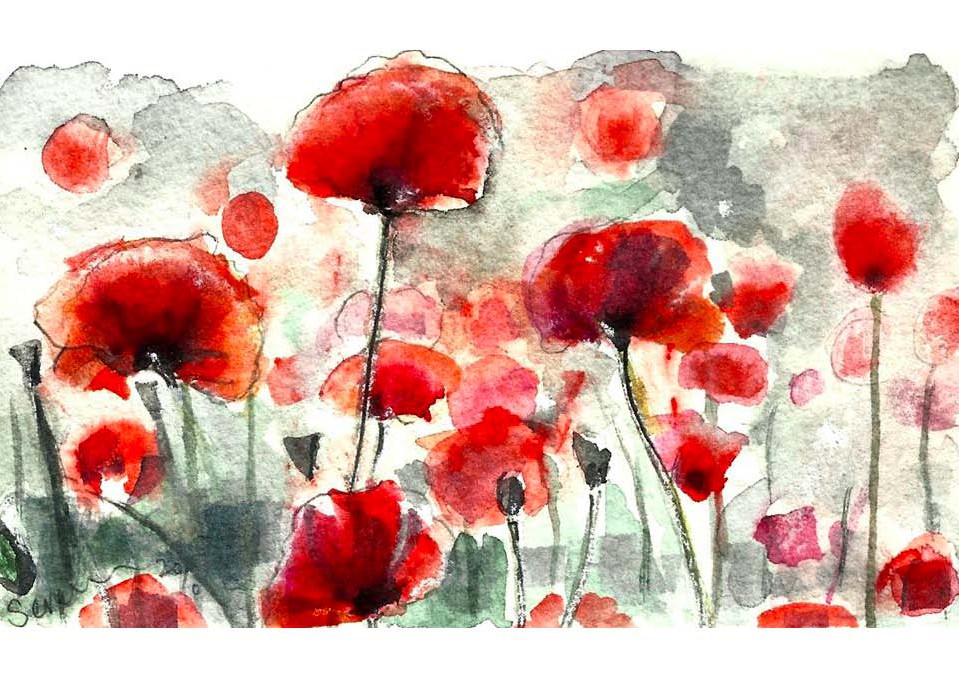
A painting by my friend Serena Stevens

A painting by my friend Serena Stevens may she rest in peace she battled cancer as valiantly as any soldier

November is a month to remember. Loved ones lost to all kinds of battles… on the front in war, of course, but there are other battles that some folk wage against disease – that dreaded, insidious, cancer; stroke victims, who wage a daily battle with bodies unwilling and unable to respond to the simplest of their wills; so many other ailments and conditions that render folk dealing with pain on a sub-chronic daily basis, the list is a long one. This November I’d like to remember them all.

I can’t name them, but they are all my heroes.

You and you and you, who see

Life ebbing by in slow degrees

For whom there was a time, I know

When nothing ever went so slow

Today your speech is locked behind

An uncooperative mind.

And you, why half your body can’t

Respond to anything you want.

And then there’s one who cannot turn

For pain that through his body burns

And there’s another one who, while

Her spirit breaks, yet she can smile.

Some have lost their limbs to bombs

And still they somehow all limp on

We know not who has been in war

But this we know, and know for sure

There are brave soldiers everywhere

Who need to know that we do care

For them, our poppies red

We wear and still a tear or two we’ll shed.

Fight on you brave immortal souls

The day will come, you’ll reach your goal.

And for those who are thinking of loved ones lost in war I have this to say in remembrance of ‘Poppy Day’.

The famous poem by John McCrae is reproduced below:

IN FLANDERS FIELDS

In Flanders fields the poppies blow

Between the crosses, row on row,

That mark our place; and in the sky

The larks, still bravely singing, fly

Scarce heard amid the guns below.


We are the Dead. Short days ago

We lived, felt dawn, saw sunset glow,

Loved and were loved, and now we lie

In Flanders fields.


Take up our quarrel with the foe:

To you from failing hands we throw

The torch; be yours to hold it high.

If ye break faith with us who die

We shall not sleep, though poppies grow

In Flanders fields.

With so many wars that have been fought since that poem was written, I’d like to change it around a bit

Forget that quarrel with our foe

‘twill only lead to e’er more woe.

And who is foe may in the end

Turn ‘round and some day be a friend.

The only faith, that we need keep

Is, to try and end each day in peace.


Let the poppies, sweetly blow

Lest we forget those laid below

And should our leaders want a fight,

And rant and rave about what’s right,

Let’s hide the guns and send them in

To face each other in the ring.

Note: This post was first published a year ago. I have reworked it for the reasons above.

5 tips for writing a memoir …

Standard

… And how I scored

The other day someone asked me if I had any tips for writing a biography or a memoir. That was a tall order. I must confess I am working on one but can no way see myself as any kind of an expert on the subject. My method, quite honestly was to plunge on. Get the story down and then work it into a somewhat linear narrative thereafter.

Why didn’t I do what I usually do, Google it? The main reason was because I didn’t want to be bogged down by external strictures, by what a regular biography should look like. I wanted the person’s own story and own voice to come through.

The memoir I am working on is almost done. But, after the question was posed I decided to see whether my method was nuts, or did it work?

I came upon an old article from AuthorHouse that suggests the following tips:

Tip #1

Have a deep interest in your subject. Don’t pick a biography subject just because you think there’s a market for that book, or because that person is currently in the spotlight. Pick someone you’re dying to know more about.

In other words, ask yourself, “If no one but me ever reads this book (or if, for whatever reason, the book is never completed), would the research itself be its own reward?”

I for one am glad to say an unequivocal YES! I have thoroughly enjoyed the process of getting to know my subject. We’ve had many laughs, tears, frustrations. But, overall it has been an amazing experience for me.

Tip#2

Be organized. If you’re a thorough researcher, you might interview hundreds of people and review thousands of documents. Simply dumping all those records, transcripts, photographs and notes into a folder with your subject’s name is NOT the way to go. Use a system that works for you.

Oh dear! Nope. I wasn’t that organised, but I wasn’t a total wreck either. I did/ do have separate folders. Fortunately, since we decided to keep it as a memoir, I didn’t need to interview a whole host of people so I didn’t have to check and counter-check with others who would, perhaps have given different versions of the same account, a la Lawrence Durrell’s Alexandria Quartet.

Tip#3

You don’t necessarily need a new subject—just a new angle. Just because your person of interest has already been written about before (perhaps many times), it doesn’t mean there’s no place for your biography.

This didn’t apply to me or the subject, because the story is unique and there aren’t that many accounts of the person’s life for us to worry about. Besides, it is very much an authorised memoir.

Tip #4

Don’t delay, especially with interviews! Once you’ve decided that you want to write about a particular person, get started as soon as possible. Why? Because interview subjects will, unfortunately, pass away eventually. Waiting a year, a month, or even a week could result in the loss of an eyewitness or a close friend of your subject.

Again, this didn’t apply… thank God! But we had got the bulk of the story down fairly quickly. In spite of a hectic schedule, we met twice a week. My subject is a very focused individual and after a few preliminaries, we wasted no time. I am very impressed by his prodigious memory and tremendous sense of story-telling. I felt I was there, witnessing each event he talked about. That’s why sometimes we’d both end up laughing or emotionally drained.

Tip #5

Be thorough. Because, after everything you also have to write the book!  Follow leads, pursue hunches, and research your subject exhaustively—but don’t forget to write the book! At some point, you have to make a conscious decision to stop digging and start typing.

As you do your research, you might be able to fine-tune the scope of your project, which will narrow the parameters of your research.

My method was to write along. As soon as I had finished the interview sessions I would transcribe the session and keep that in a separate folder. The next day, or sometimes, that very night, I’d get into trying to “write the story” as a story.

This worked to some extent, because, after a very thorough (and I may add: sharp) review by the editor, major chunks of the book had to be moved around and rewritten. Some parts had been repeated and some were inconsistent.

To the above AuthorHouse tips, I’d add a sixth…

PLUS ONE!

Get a good editor. Preferably someone who is not associated or emotionally connected with your subject.

This was a great help for me. Because, although on reading my editor’s comments I was initially devastated, when I returned to fixing the manuscript, I found that perhaps the emotional distance had helped to bring clarity. We are always far too close to our own work – especially long pieces – to see the errors.

And that’s about the size of it. I’m sure there are many other resources for writing a biography or memoir, but if this helps even one fellow writer, I feel I will have done something today.

Do you believe in ghosts? She asked…

Standard

Yes, was my unabashed reply. I won’t go into the details of personal experiences, strange happenings and other worldly feelings that I have had over the years, but in the end, yes. I believe that there are spirits of people who have ‘gone on’ that seem to reach out and connect to those on this side of death.

The spirit doesn’t have to be a loved one. Sometimes it is, quite literally, a lost soul still searching for someone to leave a message, to make a connection, who knows. Are the spirits malevolent? In my experience, no; but, there are times when these visitations seem to carry a forewarning to those amongst us who are alive.

Opinions on the subject vary, sometimes there’s a ‘logical’ or psychological explanation for what various folk have experienced. But, there are times when neither logic, nor science, nor ‘ghost-busting’can penetrate that veil.

As that famous line from Hamlet goes:

There are more things in heaven and earth, Horatio,
Than are dreamt of in your philosophy…

In the spirit of that, and with no pun intended, today I was mesmerised by these tales, purported to be true:

49 Real Nurses Share The Terrifying Hospital Ghost Stories That Scared Them To Death

Vengeance Wears Black…

Standard

41ztQAFKyyL._SX323_BO1,204,203,200_…And poor time management goes around in rags, tattered in the attention that a book as action-packed as this one rightfully deserves.

In spite of all the swirling minutiae of daily commitments – from an event in the offing, to freelance work, household chores, to inane queries with regard to said event – I couldn’t pull myself away from Seumas Gallacher’s Vengeance Wears Black and yet I constantly had to; dangling participles notwithstanding.

The book haunts one through its deft handling of the personal interplay and commitment of the main characters to each other – all partners in ISP International Security Partners. These include our hero Jack Calder and May Ling his wife – and the team Mr. Brains Jules Townsend and Malky McGuire: friend and colleague.

The bloody explosive action kicks off and kicks one in the stomach right from the get-go. I wonder if this is a typical Seumas Gallacher opener – having read the Violin Man’s Legacy a little over a year ago. The opening scene in that earlier book is a real stomach-churner.

Vengeance Wears Black starts with a tense human trafficking operation in Krakow that goes horribly wrong. It then leaps across to London where another eruptive incident brings our main players together. This time a Gurkha colleague smothers a grenade with his body thus saving his friends from ISP – a band of tough action-hardened SAS men and one woman; who then carry out a carefully planned, meticulous operation that not only quells the violent turf wars raging between Asian triad gangs and Eastern European mobsters, but also avenges the death of the man who saved their lives.

Seumas Gallacher’s book takes the reader on a nail-biting ride from east to west, from unimaginable debauchery and corruption to uplifting moments of friendship and care. I, for one, was glad of these little hiatuses in the action as they allowed me to get to know the main players, become involved in their fates, and follow the detailed planning that goes into such a far reaching operation.

This isn’t a genre I usually read, so I was surprised by how much I was drawn into it. I had read the earlier book so I knew the background of the characters but, being a stand-alone novel, it is not necessary to read it to follow the action or the connections.

These books would make a superb movie or TV series and I’m sure one of these days someone is going to discover them. Then we’ll see Mr. Gallacher’s name in lights, with our hero Jack Calder blazoned across the posters a la Jason Bourne/Matt Damon.