Category Archives: Could be Verse

Memories

Standard

In search of material from the past one comes across a mood that suddenly finds resonance in the present. It’s not prophetic but it stirs an old emotion and I wrote it when I first knew we were going to Canada. I was apprehensive at the time, not knowing then, what I know now, that I was embarking on one of the best times of my life.

Having said that, I feel that those of us who come to the Middle East, even if we put down roots here, imbibe something from the shifting sands that enters our spirits and stirs a restlessness within us that eventually makes nomads of us all. Where, beneath this great dome of sky, will I eventually pitch that tent that never needs to be unpegged again? I have sand in my toes.

A Farewell

Goodbye people of this clime

It’s time to leave you

My watch is over

The grains of rice

Destined for me, are eaten.

No more grains on these plates

Come with my name written on them.


I have drunk deep

Of your waters, and long.

A thirst in my heart

Has been quenched.

And now a gnawing hunger

For other pastures

Feeds at my soul.


I must leave

The writ has been sent

Am I manumitted now?

Or do I go to another master

Another slavery?


The only freedom I yearn for

Is the final escape from life

When I will hunger no more,

Nor thirst.


I see your trees your wastelands

Your messy beaches, your prim hotels

I know your petty interests

Your magnanimous natures

I’ve grown to love them all

And I’ve grown to love them well.


But I must leave now

For I can hear the sirens calling

Midnight beckons

With its own sweet, soft music

Which I must follow

Towards the harsh light

The unforgiving break of day.

Seven dangers to virtue…

Standard

And five verses on one!

I have a very talented bunch of school friends and every day we exchange a rather large number of emails. Sometimes there are short little exchanges at other times we have long and serious discussions, we share jokes, tease each other, occasionally we have violent (and vociferous) differences of opinions and occasionally these take the form of impromptu verses.

Here’s the result of a recent exchange.

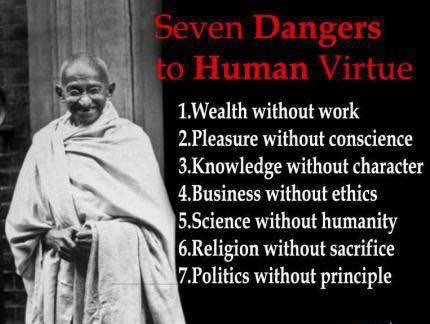
Our friend Rajpal, in the spirit of the passage of the past year when thoughts turn to introspection, sent a post that claimed there were Seven Dangers to Virtue attributed to Mahatma Gandhi.

IMG_2797-2

This was accepted by the group with sage and solemn agreement. One friend, Pavan, decides he’d add one more danger to human virtue, claiming that, “One could add another. Desire without rationality.”

Well, I thought, desire is irrational.

And so I challenged him with the following comment, “My dear friend the trouble is Desire knows no reason; it is, and therein lies the sting.”

That last phrase set off my rhymester bells and before I could control myself, out came this verse:

Heart and head they will not meet

Heart responds just to the sweet

For often when the head says no

The heart, dear heart, it will say ‘go’.

And when the heart heads for a fall

The head it says, ‘I told you so’.

Philosopher friend Pavan bats this back at me within minutes:

Crave on dear heart, for life is short
Let not the head, thy zing abort.
To fall and hurt is also gain
For what is life without some pain.

A third friend nicknamed ‘Kandy’  jumps in with:

The head and heart are never in sync
But do not let your spirit sink
Go ahead with all your zest
Get what you want and like the best.

Now I had to respond to these two and at least try hold up my end of the argument. So…

Love it!
And therein speaks the heart
For versifying is an art
Well said dear Pavan you are right
And so say artists, with all their might
’tis better to have loved and lost
To have your heart in tempests tossed
To give your might, your main, your all
Than never to have loved at all…

But…
That’s the crux of my lament
Love and desire know no reason
Nor do they follow any season
And so you prove my argument!

In leapt Avinash – not in verse – reminding us that in a battle of wills between head and heart, most times it is the heart that wins. Finally, Mallika, our master poet, counsellor and chorus all in one, rolled out the final poem in the series…

Rajpal is our conscience keeper, he
Brings us our daily homily!

To the seven evils the Mahatma bade
Us save ourselves from, Pavan could add
Another, and as is our wont, you’ll see
Our ever youthful gang of G&G
Concentrates our talent on the eighth
Far more meat in that one, i’faith.
But Avinash made the connexion plain
Desire and Pleasure are brethren twain!

But Love – that’s a whole other ball game;
And that’s the one Rohini’d blame
For the Human Condition (with apologies
to Hannah Arendt, for her treatise
Placed procreation at the level of Labour –
But Love’s a task none would abhor!)

Arun Kandy joins the team, with yours truly
Bringing up the rear, with many a rhyme unruly!

Twixt Head and Heart, both, we must agree
Are ruled by our chemical inputs; verily –
(Like Pavlov’s dogs) what we eat are we,
And our choices are really not that free!

Superb argument. Case adjourned… unless of course our readers wish to add their views here!

Of Woods & A Woodpecker

Standard

E-mail exchanges give rise to some goofing around for me. Here’s a little joke that is perhaps doing the rounds,

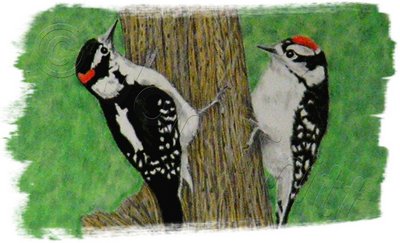
Two Woodpeckers

Mail Attachment10This Mexican woodpecker and a Canadian woodpecker were in Mexico arguing about which country had the toughest trees.
The Mexican woodpecker claimed Mexico had a tree that no woodpecker could peck.

The Canadian woodpecker accepted his challenge and promptly pecked a hole in the tree with no problem.

The Mexican woodpecker was amazed.

The Canadian woodpecker then challenged the Mexican woodpecker to peck a tree in Canada that was absolutely ‘impeccable’ (a term frequently used by woodpeckers).

The Mexican woodpecker expressed confidence that he could do it and accepted the challenge.

The two of them flew to Canada where the Mexican woodpecker successfully pecked
the so-called ‘impeccable’ tree almost without breaking a sweat…

Both woodpeckers were now terribly confused.

How is it that the Canadian woodpecker was able to peck the Mexican tree, and the Mexican woodpecker was able to peck the Canadian tree, yet neither was able to peck the tree in their own country?

After much woodpecker pondering, they both came to the same conclusion:
Apparently, Tiger Woods and Shane Warne were right, when they said,
“your pecker gets harder when you’re away from home”.

This resulted in the following rhyme from yours truly:

Mail Attachment9How much wood, would a woodpecker peck
When a woodpecker pecks a tree?
As much wood as Tiger Woods would
When Tiger Woods drives off from a tee!
And the ball, as happens to many a ball,
Goes whizzing into a tree.
And knocks out a piece as big as yer fist
While Woods, of course is pissed!
So is our woodpecker pecking the tree
For he’s been struck in the head like a tee
And his pecker’s been put out of joint
So he screams at the top of his voice and says
“Yer s’posed to get to the pin ya git!
Don’t you know that that’s the point?”
“I know,” says Woods who’s in a bit of a dither
“But my iron’s not as hard as my pecker.”

Black by Oak

Standard

Looking back through my folder and in an attempt to clear it of its clutter I came across this little gem from our philosopher poet Omar Ahmed Alkhulaqi, aka Oak/ OAK. He is now creating his own style of Instagram Verse, if there is such a thing, the appellation is mine.

The following came into existence as part of an exercise at one of the BWC’s (Bahrain Writers’ Circle) Creative Writers’ Workshops. We were all asked to express the word: Black, and this was what our poet created.

“It is the absence of all colour, the abode of secrets in the night. It is the domain and perpetuator of mystery, rooted from the ages by man’s fear of the unknown. Its ambiance resonates from its ambiguity. A frequency of doom that sets in motion the strings of terror, while the mind expands and the senses retaliate, the strings shudder and vibrate. A resonance grinding to sweep away the dusty soul and awaken the inanimate and the forgotten. An instigator of curiosity that leads to questioning, a descent of light into nothigness and the defeaning of sound into silence. It removes security and familiarity and induces a pulse of danger and vulnerability. Like a veil it blinds the eyes unbiased and unmerciful , the senses arise to fight for their survival, the terror smitten rationality struggles with irrationality. All that is grave and evil lies waiting, offering a freedom away from the light of day either to better understanding or tribulation. A menacing darkness that pervades the spirit, announcing its menace with banners of an insulting army whose motto is ‘Woe to the conquered!’.

It is a dream that finds purpose in its existence because of absence in things, taking the shape of unanswered questions and stalked by their immortal King– Death. A dream writhing to and fro, in and about and exciting the senses to the mystique. Black is of danger, freedom, courage, contemplation, vulnerability, sorrow, pain… It is bitter when denounced and sweet when marvelled. It is shadowed by darkness, and there all forsakes you, even your own shadow. For it is a colour that excites many things and is as deep as our peaceful sleep, and above all–indispensable.”

Note: You may find more of this delightful poet’s work on Facebook here:

https://www.facebook.com/omar.kuladi?fref=tl_fr_box&pnref=lhc.friends

And on Instagram follow the handle @b.t.oaktree and check out more here:

https://instagram.com/b.t.oaktree/


The Sandwich Thief

Standard

Yesterday I read a post on Facebook (someone else’s post) that I then placed on my FB page here: https://www.facebook.com/RohiniSunderamAuthor

The post is an amusing account of two colleagues and a spat they have over a turkey & rye sandwich. I mentioned that it reminded me of some of the poems in Corpoetry, like The Water Cooler. One friend said she’d like to see what I’d make of that situation in a poem.

And so, here it is!

‘Twas in an office, I heard tell

Of a prankster ne’er do well

He stole, it seems, a colleague’s lunch

And the outcome was a bunch

Of laughs for folk like me and you

But from the posts, it seems ‘twas true

And this is how it went:


“Oh sandwich thief, I know you keep

Stealing my sandwiches, why oh why?

The latest one’s turkey on rye.

Grow up you thief, you sandwich thief!”


The thief replied, “dear Turkey ’n’ Rye

I have it here, I do not lie,

Ten bucks is all that it will take

To get it back upon a plate.”


The victim lashed back with a threat:

“Return my sandwich, thief, or else!

To HR I shall take my ‘plaint

And then let’s see how you will faint!”


The Sandwich Thief, did threaten back

“Alas, my dear, alas, alack!

For every hour that you delay

Bite by bite, I’ll eat it away.”


Threats then turned to psycho chat

“Why oh why are you doing this?”

The sandwich ‘napper, not remiss

“Tick-Tock” he sent a photo back.


But in an office, as we know

Don’t push your luck for it can go

As in this case, to HR’s top

And HR weighed in with a ‘Stop!


“Cease! Desist! Return the food

And we’ll not take this any further”

But sandwich ‘napper he’s a boob

Demands a pizza, silly joker.


Next he adds an insult in

Threatens not to eat but chew

And then in little mouthfuls spew

The sandwich in a bin!


“You’re the worst” our Victim sighs

“I’m not” Our Sandwich Thief replies

And in eloquent prose outlines

The corporation’s ills and its demise.


Now, thanks to IT and what not

HR tracked down the wicked sot

“Francis!” they name and shame the chap

“Come and see us, now ASAP!”


Now Sandwich Thief, he ain’t so bold

(In fact it almost makes one sicken)

“Please don’t fire me,” he folds!

The turkey made him chicken.


More from Aman

Standard

#16968-eps_needle-thread

What do you say

To the needle that pricks you

While you sew?

There’s no one to blame,

There is only you!


T’was destiny that put you there,

And from here on

Who knows how we’ll fare.


Rocky and even

And up and down

There sits the king

For him I’m a clown.


What do you say to the

Needle that pricks you?

To some quite a lot,

And to a lot just a few.


Shush now! They say,

‘Tis just a pin prick they say

But,

That was my last drop,

If only they knew.


#2

So smile now,

And look on,

On the horror of things unfold.

These are made of your nightmares,

Look on,

As the warm wind turns cold.


So smile now,

Even though you shake and shiver.

At heart you know there’s no hope,

Nay, nary a sliver.


So smile now.

There’s no room for fear,

The beast can smell it,

Don’t let him get near.


So smile now.

‘Tis only the beginning.

The nightmares unfold,

As you feel

Yourself

Sinking.


Testing the water

Standard

Three poems by Aman

#1

Uncertainty unbound

The walls made of bricks

Hold no solace,

The hum I recall is gone!


I move to the unknown,

Yearning for the song

Which perhaps may be my own


A long wait it’s been

To hear the sound

That beckons

To the far horizon


And should the note ring true

Will I really reach that elusive hue?


#2

To yearn for a grand morrow

to have striven for the ray of thought

only to realise you’re happiest with your lot.


Know your need, not the want, ‎the path reaps the price,

Alas only the old now realise.


Even the “great” in death strive to tell us,

we depart empty handed‎ the way “He” had made us.


‘Tis just me, young in body tho’ old in mind‎,

How fortunate, I understand, there is yet time.‎

 #3

The words that you see; mean not what they say.  The path that we follow will lead us astray. A pinnacle we reach, clawing our way through a shroud, all we achieve is a modicum of doubt. Let not the rational lead you otherwise, the path turns to thorns, in our twilight we realise. Break out break through for you and your own; like Charles did eons ago unknown. We build but to no avail; our bones will turn to dust no matter o’er whom we prevail.


David Hollywood of Bahrain Confidential reviews Corpoetry

Standard

David Hollywood, my friend and fellow poet from the Bahrain Writers’ Circle (BWC) has the happy post of being the resident poet for one of Bahrain’s best known lifestyle magazines, Bahrain Confidential. David, as all of us in the Second Circle Poetry Group know, is an impassioned and accomplished poet with his book Waiting Spaces available in both print and Kindle editions. And, of course he has been writing poetry for Bahrain Confidential for several years now.

You can imagine, I was overjoyed when Bahrain Confidential told me that he was going to review Corpoetry, my collection of poems published by Ex-L-Ence Publishing. I was also a little intimidated. Now that I’ve seen his review – which I hope you’ll check out – I am absolutely and utterly delighted.

David and I share approximately the same vintage, so he picked up on references that were old hat but which I’ve explained in notes to those who are of a younger persuasion. The one poem that he, and a number of others, particularly enjoy is Big Cheeses.

Which poem or poems resonate with you? Do let me know. Also, if you’re inclined, do please send in a corporate situation and I can create a poem for you. If you prefer to write your own poem, leave it here in the comments section where it can be featured.

Here’s the review!

Feb-Book-Club-470x330-470x330

With the link: http://www.bahrain-confidential.com/home/bookreview-corpoetry-by-resident-poet-david-hollywood/

Enjoy! And once again thank you David Hollywood


The Lament of Gilgamesh

Standard

This poem was written when I was in Bahrain in the 1980-90s. The Legend of Gilgamesh has fascinated me for quite a long time and continues to do so.

For those who don’t know it, here’s a quick run-down garnered from Wikipedia: The Epic of Gilgamesh is a poem from Mesopotamia and among the earliest known works of literature. Scholars believe that it originated as a series of Sumerian legends and poems about Gilgamesh king of Uruk – which is in present day Iraq.

The story revolves around a relationship between Gilgamesh and his close friend Enkidu, with whom he undertakes many dangerous quests that incur the displeasure of the gods. In one of these quests the two friends kill the Bull of Heaven and so to punish them the gods have Enkidu killed. The latter part of the epic focuses on Gilgamesh’s distressed reaction to Enkidu’s death, which takes the form of a quest for immortality. In this quest Gilgamesh tries to learn the secret of eternal life by undertaking a long and perilous journey to meet the immortal flood hero, Utnapishtim and his wife, who are among the few survivors of the Great Flood, and the only humans to have been granted immortality by the gods. Gilgamesh comes to the twin peaks of Mt Mashu at the ends of the earth through the mountains along the Road of the Sun. He follows it for twelve “double hours” in complete darkness. Managing to complete the trip before the sun catches up to him, Gilgamesh arrives in a garden paradise full of jewel-laden trees; in another legend this is the place referred to as ‘Dilmun’.

Gilgamesh notices that Utnapishtim seems no different from himself and asks him how he obtained immortality. Utnapishtim tells an ancient story of how the gods decided to send a great flood – very similar to the Flood in the Bible and Noah’s Ark. The main point seems to be that Utnapishtim was granted eternal life in unique, never to be repeated circumstances. After instructing his ferryman to wash Gilgamesh and clothe him in royal robes, Utnapishtim prepares to send him back to Uruk. As they are leaving, Utnapishtim’s wife asks her husband to offer a parting gift. That’s when Utnapishtim tells Gilgamesh of a boxthorn-like plant at the very bottom of the ocean that will make him young again. In some stories it is the pearls that are considered the “grapes of the sea” that will grant immortality. Gilgamesh obtains the plant by binding stones to his feet (very similar to how the early pearl divers of Bahrain used to descend to the sea bed) so he can walk on the bottom of the sea. He recovers the plant and plans to test it on an old man when he returns to Uruk. Unfortunately, when Gilgamesh stops to bathe, the plant is stolen by a serpent, which sheds its skin as it departs. There is a lot more and it is a far more complex epic than I have placed here.

In the Epic, Gilgamesh returns to Uruk, however, in my imagination, he never really leaves and the following poem draws on several myths around ancient Bahrain, using different names by which it was or supposedly was known – Dilmun, Tilmun, Nidukki, Kur-ni-tuk. Those interested may explore these further through that wonderful resource the Internet.

South, south he rushed

To the midst of the sea

To the place of the rising sun

To the place where some day

A king would live like a fish

Twelve double hours away.


The fifth king of Uruk was Gilgamesh

Descended five times from the time of the flood

And son of the goddess Ninsun

He sailed for a day

He sailed for a night

He sailed in search of Dilmun.


He wished to eat of the grapes of the sea

Those pearls from its bed would grant him

Eternal bliss and companionship

With the sage king Utnapishtim

In legendary Dilmun

In twice-blessed Dilmun.


Twice blessed by the god of sweet waters

Twice blessed by the god called Enki

So south he rushed south by southwest

And he met with a following wind

Until he came upon this jewelled isle

(A sad, far cry from Sumer).


Here the date palms stood tall sentinels

Their green arms stretched to the sky

Waving a warning from dusk until dawning

That this idyll would soon pass by.


But he heeded them not brave Gilgamesh

For he had reached the isle of his dreams

Then Gilgamesh dropped anchor

And entered the waters green

Where betwixt the salt through the seabed rose

The sweet waters of Bahr ein.


With stones on his feet down, down he dived

To the rocks where the pearl beds lay

He closed his eyes against the salt

He pinched his nose with a date palm peg

While he harvested those pearls of rose and grey

Harvested the grapes of eternal day

In the twice-blessed waters of a tiny bay

Off the island of Muharraq near Bahrain

Off the waters green that spread between

Muharraq and Bahrain.


How long he stayed beneath the waves

Neither he nor the sages could tell

But he took many shapes beneath the seas

Once a dugong shy then a dolphin spry

Then a shark then a dolphin again

And he sang a song a lament forlorn

Of what he saw had been done to Dilmun

And this was its burden long:


“Ah me Dilmun, Tilmun!

What became of your bearded palm trees green?

What became of your shingled shores?

What became of your soft undulating sands?

Of the burial mounds of your immortal clans?

Who has broken these temples and laid them bare

So that emptied and hollowed and ravaged they stare

At the sky and the taunting sun?

Ah me Nidukki!

Did the oil then come?

As Mesopotamia of old had foretold?

And is it true Kur-ni-tuk

That your pearls you forsook

For the sake of the black, black gold?”


And at night when a full moon is in the sky

And a Sambuk is sailing silently by

Old sailors at their fish traps say:

If you hear the shudder of an oil-tanker

Start up on a night such as this

Emanating from the sea comes a moan and a cry

And the lament of Gilgamesh.
In a Bay off old Muharraq

Standard

This poem was submitted to Lucid Rhythms – an online magazine – and when he accepted it, that was the first time I began to hope that there were still venues that would accept ‘rhyming’ and metric poems.

I don’t know the journey that the genre has taken ever since I last studied it, but in my humble – and not so elevated opinion – any art that needs excessive analysing and interpreting and that can’t or doesn’t connect with people is somewhere missing the point.

In a bay off old Muharraq

Lies an ancient wooden Sambuk

That still goes out on moonless nights

Searching for th’ eternal light

And the master of the Sambuk

Who’s the master of that Sambuk?

A ghost, a wraith, a memory

Singing songs like Fidjeri.


And who is it that sits beside him?

Playing on the double hand drum?

Drumming on the mirwas lightly

While the Sambuk skips so spritely

Across the waves out to the sea

Recalling ancient memory?

Why he too is a distant past

That’s lost forever, lost alas!


And what is it they hope to find

Tossed along by wind and mind?

Why it’s the lulu treasured pearl

‘Durrat’ more prized than any girl.

And so the divers scythe the waves

Seeking what we all so crave

To bury hatred, soothe the pain

So we can all be one again.


And all who live upon this isle

Wherever he or she may come from

Join together, hug and smile

And truly say, “Salaam alaikum.”


Note: Fidjeri is an old Arabian Gulf/ Khaleeji pearl divers’ song, mirwas is the double handed drum that pearl divers used on their dhows (like the Sambuk) the lulu is the word for pearl in Arabic and Durrat is a particularly highly prized pearl. Muharraq is the second major island of the archipelago that constitutes the Kingdom of Bahrain. The poem is not political but expresses the desire to recreate a more friendly unified time in Bahrain. Salaam alaikum means ‘peace be upon you’.