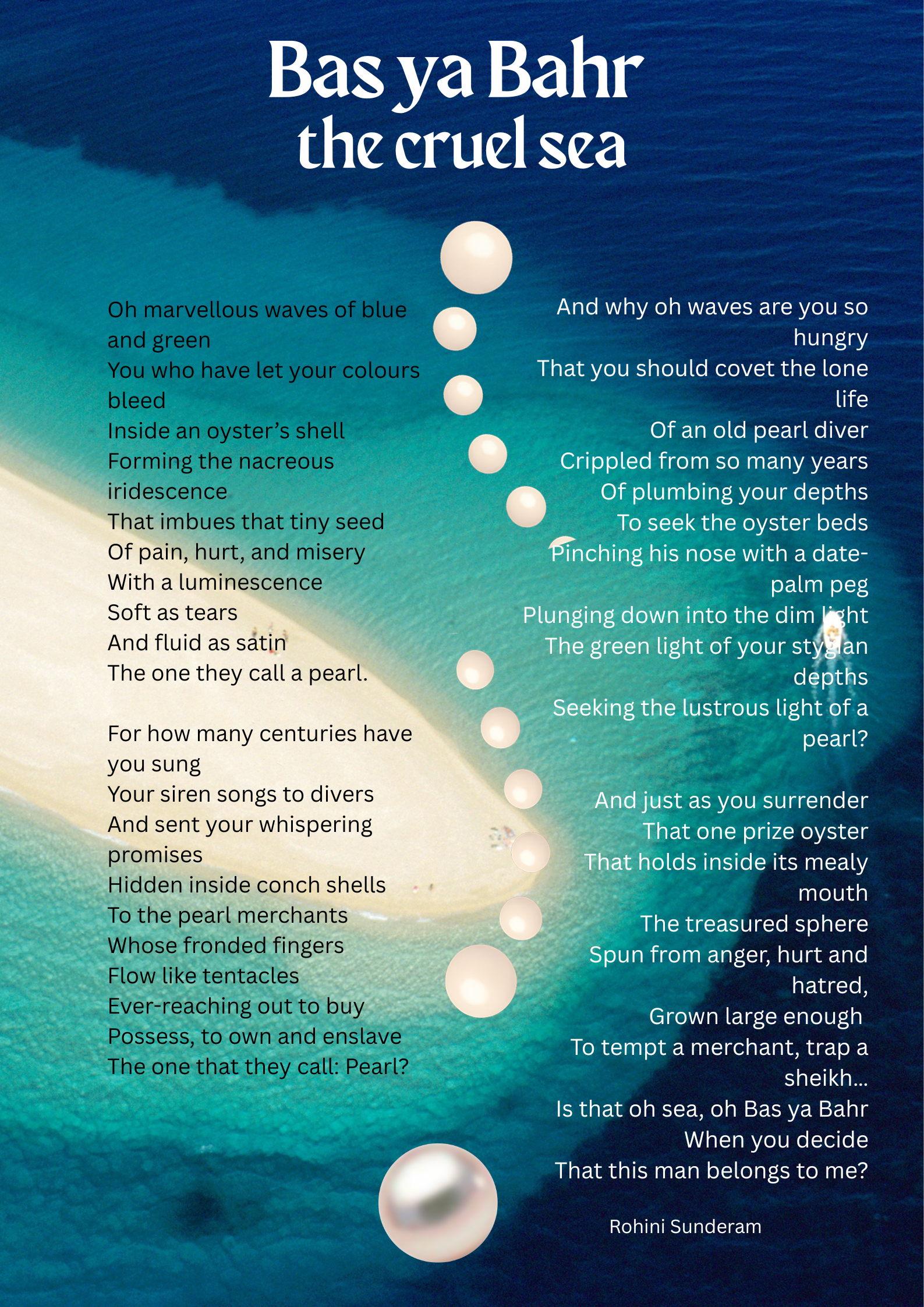
As often happens these days I was searching for another poem when I came upon this one. I thought I’d give it a visual interpretation. I hope it works.
Let me know what you think…
In Bahrain and other parts of the Arabian Gulf, the Pearl divers went out to sea to look for pearls in, what were at the time exceedingly the rich oyster beds located in and around the gulf. It was a hard life and dangerous and much lore surrounded the profession and the songs. This traditional music, known as fidjeri, is an age-old repertory of vocal music sung by the pearl divers of Bahrain, Kuwait and Qatar. The Nahhaam, or pearl diver singers, were backed by a chorus of singers and clappers accompanied by the Mirwas – a small double-sided drum – and the jahlah – a clay pot.
In 1972, a film by Kuwaiti Khalid Al Siddiq, titled The Cruel Sea – better known by its Arabic title Bas Ya Bahr – related an artistic representation of the pre-oil life of the pearl divers. It proved to be a masterpiece and tells the story of a crippled old pearl diver who tries to prevent his son from taking up the trade because it is so fraught with danger, but the son is in love with a girl from a wealthy family and needs to make money to marry her. This poem hints at the story and the theme of the film, the sea: treacherous, unmovable, unchanged, eternal and ultimately cruel.
The so-called winter in Calcutta pushed the mercury to 25C. One moment the wind was warm, heavy with humidity blasting up from the Bay of Bengal carrying with it a reminder that this had all once been a swampy rainforest. The next moment it sent us a chill message from the faraway Himalayas, it’s still winter.
My belly was large, bulbous, weighed down by the baby. I’d taken to wrapping a shawl around my waist to help support my stomach. The kicks and rolls, the tiny fist jabbing inside me had gone from a tickle that made me giggle to a physical pain. “Your previous caesarean scars are stretching as it’s growing,” the doctor had explained. 1980 was a time when an ultrasound just confirmed that the baby was okay. We neither knew nor cared about gender.
The ‘IT’ was the baby. The doctor’s face was implacable. Bedside manners hadn’t become fashionable yet. “Rest”, he advised me. His expression was stern the lines drawn down from his spectacles to his jowls were twin wrinkles, pushed deeper by bulbous cheeks. ‘Too much macher-jhol* and rice’ I thought. Back then patients didn’t make cheeky comments to their doctors.
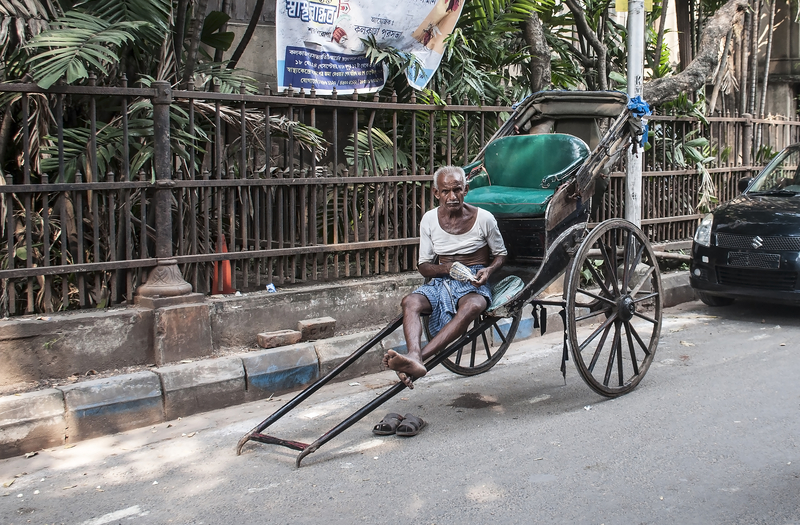
When I limped out onto the street, I was close to tears because getting a cycle rickshaw to take me home at mid-day would be impossible. It was too far to walk and too close for a taxi to bother. I looked around and saw an old hand pulled rickshaw runner. He jangled his single large bell, that looked like the tiny ghungroo bells worn by classical dancers on their ankles. I hadn’t taken a hand pulled rickshaw until then, it seemed so demeaning to them. Reminders of the British Raj, still so omnipresent in Calcutta, were interrupted by a sharp twinge of pain. I grimaced.
He smiled, waving a fly from his grizzled face. “Daughter, where do you want to go?”
“BBD Bagh,” I said, “How much?”
He quoted a price. I readily agreed and clambered onto the rickshaw, landing with a thump on the seat as I thanked him profusely.
“I thank you,” he countered, “Not many people take our rickshaws these days, it’s my only livelihood. And many of us must give up the job.” He panted. His slow pace had picked up to a steady jog, “we barely make enough for our daily food.”
I watched his thin sinewy legs as they pumped up and down. His feet were bare and thickly calloused from years of hitting a hot tarmac.
Guilt, like a monsoon shower, washed over me when he stopped in front of my building. I wanted to make it up to him. “Where do you get your rickshaw bell?”
He laughed. “Why?”
“I want it as a souvenir,” I said.
“You can take this one,” he offered.
“How will you call your fares?” Tears of remorse pricked my eyes. “What had I done?”
“I have an extra one,” he said, pulling up the seat where I’d been sitting. Under the worn red leather cushion, he had stored his meagre belongings, an almost threadbare grey blanket, rubber slippers, an extra loincloth, and striped underwear. He pulled out the grey, aluminium bell with a leather thong strung through the hoop at the top.
“How much?” I asked. A cool breeze washed past me, a benediction, for my good deed? It cooled the perspiration around my neck.
He laughed, a few teeth were missing, the rest stained red-black with betel juice. His dark sun beaten face and grey beard were almost demonic, but his jet eyes were gentle and the crow’s feet crinkling in amusement made me smile.
“Whatever is easy for you madam. I bought it a long time ago.”
I handed him thirty rupees, “for the fare and the bell.”
“Madam, it’s too much.” His jet eyes glistened with emotion.
“From the baby and me,” I whispered, “Give me a blessing.”
“Of course, of course”, he said coughing up phlegm which he spat into the street. That was Calcutta. “Live long, daughter, bless you and the baby.”
‘May it be normal,’ I say in my mind. It’s the closest I’ve come to praying in nearly twenty years.
I put the bell into my handbag which I slung over my shoulder. Then, holding my belly under my shawl, I climbed the steps to the door, pushed past it into the cool dark foyer. I pressed the button for the old black wrought-iron lift that clanked on its way down.
I felt lightheaded when I got home and lay down as the various helpers got me water, tea, and turned on the fan.
When I awoke, I was being rushed on a stretcher past green curtains. My doctor and an elderly lady anaesthesiologist were rushing beside me. I wanted to ask, “what happened?” but my tongue was stuck to my palate, and I couldn’t get any words out. I knew where I was. Had I fainted? Where was my husband? I was in pain; his hand was on my arm. “It’s all ok”. His voice was husky.
I slept again. Jagged neon lights slashed my abdomen. Pethidine. Is my baby ok? In the early morning dark, tears burnt my eyes. Until the previous afternoon when I bought the rickshaw puller’s bell, I had abandoned God and prayer.
I tried to say, “Our Father…” but it stuck in my throat. I demanded of Him, “Give me my baby whole and complete, and I’ll return.” It was a promise. A challenge. Not a prayer.
“Your baby,” the nurse said, and I took the little girl in my arms. She had a shock of thick black soft hair. I put her to my breast, she sucked hard at my nipple. Her will to live hurt. I examined her fingers, toes, face. She was perfect.
I reached in my handbag for a tissue and felt the rickshaw puller’s bell, “Your birthday blessing,” I whispered.
A pink dawn cracked the sky. I looked heavenward, “Thank you.”
This post is written by an old schoolmate and friend, Anjan who belonged to a time when we dreamed impossible dreams. He is one of our crazier school friends who has plumbed life and experiences to their limit. Today he is a “Beacon of hope for better hearing” in Long Beach California where he provides professional audiological services to the community. You can read more about him on his website:Jay’s Hearing Aid Centre. And you can ask him any questions with regard to hearing and hearing loss right here on Fictionpals, and he says he’d be happy to answer them.
I was slowly floating down and down in the ocean. The light blue ocean slowly became darker and darker as the sunlight became less and less. Voices seem to fade in my mind, and thoughts became incoherent, disjointed as the futility of trying to fight back caused me to relax my body, and assist my downward journey into darkness. The pressure of the ocean water increased steadily, and gave me a feeling of complacency, and a couldn’t care less, slow mental process of silence began to build a cocoon around me as a last fight against death….
I wasn’t even looking for anything. It did not matter anymore. I heard a bottled cry. Maybe a whale around nearby. I turned and saw what looked like fishing line dangling and swaying with the currents. Another cry. Funny that sounded like a muted piano. For a quick moment I even paused to think and waited for another sound.I saw the fishing line drift closer and I woke up to a final reality. Maybe I could clutch it and pull myself to the top. I wrapped my toes around the hook and bait and propelled myself upward.
Then I was in the midst of bubbles, thousands of bubbles, accompanied by gurgling sounds. I saw a dark shadow below me and realized that it was a whale shadowing me. Again millions of bubbles. I took a chance and opened my mouth and felt the popping of some bubbles in my mouth. I swallowed them and felt fresh energy coursing through my body. Again, more bubbles, and again I got to swallow some more air. I felt raw energy in my hands and legs.
When I chose to work in advertising so many years ago I had no idea at the time that it would prove to be so much utter, unmitigated, idiotic fun. Someone, somewhere looked down on me and decided that I needed to come out of the shy shell (yes, those of you who know me now mayn’t believe it but I was once painfully shy) in which I enclosed myself. It was a self that smiled and giggled internally. The giggling I must confess sometimes burst out of control. And then I laughed with such abandon that those around me joined in even when they didn’t know what I was laughing about.
School friends, classmates… you remember. don’t you? In fact recently I met an old friend who asked me, “What happened? When did this personality change take place?”
The rains in Chennai have been devastating. The stories and news of one disaster after another including, among other things, the exorbitant price of milk, lack of drinking water, the litany is long and for the moment looks like it has no end.
However, as often happens at times like this there is good news too. The news of people helping people. In spite of everything, here’s a story that was shared on my email that was truly heartwarming.
Here is the email, reproduced from the original,
From Biju Verghese The Spirit Of Chennai
While the entire nation is debating on the “Non-sense” called “Intolerance”, there is humanity at its best in Chennai. I can tell this for sure because, I stay in Qatar and my family (wife and 2 kids aged 11 and 7) are in Chennai. With all the floods and problems, I am getting the message from them, “We are safe”.
In the wake of calamity, Chennai is “One”. It has only one religion, “Humanity”; It has only one enemy, “Water”; there is only one aim “Help”. And they did it in style. When they were offering help, they didn’t ask whether you are “Hindu” or a “Christian” Or a “Muslim”. They didn’t ask whether you are “Rich” or “Poor”. They didn’t ask whether you are a “Tamlian”, “Malayalee”, “Telugu”, “Kannadiga” or “North Indian”. Only one question they asked; “Do you need any help?”
The rich people; my neighbors who never interacted with anybody in the neighborhood in last 4 years; opened the gates of their huge house. The man stood outside and welcomed people to his house. “We will eat whatever we have. We will share whatever we have. You can stay here until the water recedes”; that all he had said.. He accommodated around 35 people in his house. He is a Hindu Brahmin. He provided mat for the Muslims to do Namaz. He allowed Christians to pray in his Pooja room.
There were volunteers outside helping people to reach safe places. They used anything and everything as tool; until the army people reached. Once the experts came, they gave the leadership to the more experienced and helped them to help others.
My wife told me that, there were group of people going through the streets with neck deep water and asking “Sir / Madam, do you need any help?” In front of every house. They provided whatever help they can and they distributed food and essentials. There were groups providing cellphone batteries for 5 minutes to anybody who want to talk.
I have seen people fight for food when there is a calamity. Even the most modern countries, when there is a calamity, people fight for food. They think only about themselves at that time. But, when the food was distributed in Chennai, it was calm. People stood in queues and they have given food for the people who are not able to stand in queues (elderly, mothers and kids). They brought boats. They made temporary rafts and just went on helping people. On top of all these things, this is what my kids are seeing. This is what they are learning. How to help each other at the time of need. It goes straight into their brain. The images gets implanted there. And then, when there is another calamity, they know what to do.. How to survive. How to get help and how to help others… This is what I want my kids to learn.. Humanity, without boundaries….There is no wonder that, Chennai is one of the oldest cities in the world. It has survived everything thrown at it.. It will definitely remain so for ever. They are united. They can beat anything.. They can survive anything… I am a proud Chennaite… I will never forget this in my life! A city which gave me and my family safety in the hour of need.. Thank you Chennai!.. Thank you Indian Army! Thanks you India!!!
I remember more than 40 years ago there was a flood in Mumbai (worse than usual) and we saw the same thing: people in neck deep water helping others with inflatable tire inserts if one couldn’t swim.I was there and this happened to me, this is no third person account! I could swim but the water was filthy like you wouldn’t believe.
It is true, when a major calamity hits I think most people rise to their highest level of humanity. And that is comforting to see and know. My son was in New York during 9/11 and the support and fellowship shown by so-called hardened New Yorkers blew him away. We saw the same in Japan a few years ago. It really is wonderful to be able to post a ‘feel good’ story right now.
God bless everyone in need. And may God help us all.
This is a children’s story that I wrote a very long time ago. I have been trying to find a publisher, ideally in India, who’d be willing to publish it as a stand alone. It’s not very long and I’m sure that with the right illustrator it would be a delightful read for children all around the globe. It’s not a traditional folk tale but has been narrated as if it were.
Here are the opening paragraphs… Tell me what you think. What’s more, ask your children or grandchildren what they think. Would they want to know more about this story?
WHY THERE ARE COWS IN INDIAN CITIES
As anyone who has been to India may have noticed, even in large cities like Bombay or Mumbai as they now call it, New Delhi, Chennai, Kolkata in fact all over India, in cities and towns there are cows in the streets.
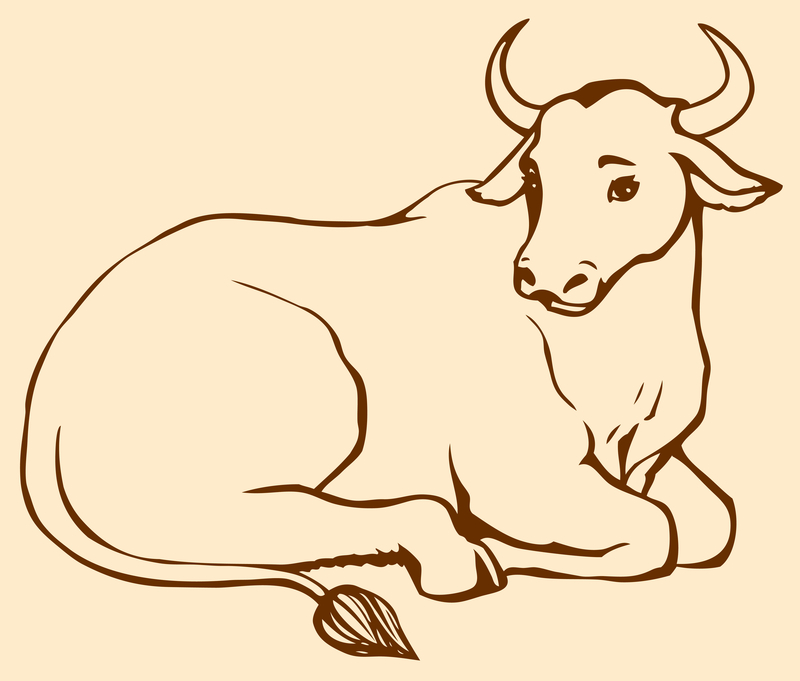
The cows are everywhere: on the roads, standing on pavements, nuzzling their heads in garbage heaps, lying on the side of the road, chewing cud. Sometimes they just stand and blink at the passing traffic. Sometimes they walk across the road. And, when they do that all the traffic comes to a respectful stop. And sometimes they just stand and stare at passersby with a look to remind them of something that happened a very long time ago.
Now, as every boy and girl, man and woman, has sometimes wondered, you too might ask, ‘why are there so many cows in big cities in India?’ And you might think, shouldn’t they all be in the villages and out in the fields? And shouldn’t they eat something other than scraps and straw and old paper? They should. But Indian cows are very clever and adaptable.
What’s more, many years ago they did only stay in and around the villages and never even so much as wanted to go to the cities. But, those were the days when there was only one cowherd for all the cows and buffaloes in India. His name was Govinda.
Govinda was a young man with a merry twinkle in his eye and a ready song at his lips. Sometimes he played a flute, and it was the most beautiful sound as it danced lightly like a butterfly over the cows and buffaloes as they ate grass, or sat and chewed the cud or slept. All the cows and buffaloes loved Govinda and he loved them.
The cows and buffaloes spoke to Govinda in a language quite different from ours. Whenever they needed him they would lower their heads and call out, “Gooooovinnnnndaaaa!” And he would come running as fast as he could, hopping, skipping and jumping over the backs of the cows if necessary. He could run very fast, there were some who said he could run almost as fast as the wind.
Govinda and his cows wandered wherever their fancy took them. If the cows wanted juicy green grass, Govinda would run ahead, pluck out a stalk, chew it from the roots to test if it was juicy enough and then he’d call the cows to follow him. When they moved in the direction they were called, the enormous herds looked like a great monsoon storm that was changing direction.
July 18th was my mother’s birthday. Every year it rolls around and every year I think of her. She was a major influence in my life and today I think I have the strength to post the eulogy I wrote for her. I wasn’t able to attend her funeral or her memorial service, so my sister read this out to the scores of people who came to pay their respects to her.
TO MY MOTHER
“Woman, behold thy son, behold thy mother.” That was one of my mother’s favourite quotations from the Bible. For son, I think we can all read ‘child’. The other was the Good Friday hymn, ‘At the cross her station keeping, stood the mother gently weeping’. For her these were like guiding lights. And, she was above all else a mother, as fiercely maternal as a Bengal tigress. I think she would have liked the metaphor – no, she’d correct me, that’s a simile. And, although many of us in our family were at the receiving end of her particularly well-honed tongue, I think I can confidently say that we had all also been at the receiving end of her maternal care. She has comforted, helped, taught and just plain ‘been there’ for more people than I think I’ll ever know. A little thing could move her from being a towering inferno to a tower of strength. And only ma could get away with combining both.
Speaking for myself, she taught me everything, from school lessons to the big one about life. Not so much by what she said as by her actions. From as far back as I can remember she embodied what today people would call ‘feminism’. She didn’t hang a name on it. She just went out there and did it. I’ve seen her playing squash in a sari. I believe she played a deft game of tennis and badminton too. She swam, unembarrassed, in a swimming pool at a time when we rarely saw other women even get into the water. She drove a car long before we saw other ladies drive, at any rate in some places in India places like Bangalore and Jamnagar way back in the 1950s. She was a strong woman with very definite views and we secretly nicknamed her sergeant major.
Thanks to her, we had boyfriends and broken hearts and she was always, I now recall, not obtrusively there, but there; with her ‘there’s many more fish in the sea’ wisdom. Afraid as we often were of her, we knew that we had no stronger champion when it came to doing something new, different and perhaps not popular with the older generation of my time. I remember her interest in theatre. She took part in a play for which I helped her learn her lines but I wondered how she could stand up in front of all those people. She gave me an interest in Art, and took us to dozens of art exhibition that we enjoyed and they weren’t school trips. Books, we shared. I recall my mother giggling out loud over a book called Aunty Mame and then laughing over it myself. Poetry. And with the passing years I’ve found myself digging around in the garden finally coming to her enjoyment of plants and the regeneration that they represent.
Today, more than anything else, that’s what she would like us to celebrate: the regeneration of her love. Growing, and like the earth, giving forth of its bounty, where our tears are merely the rain which makes flowers called Smiles, Laughter and that most beautiful rose of all, the one that’s called Remembrance.
Long, long ago King Jagata, which means the world, lived happily with Queen Dharti Matá whose name means Mother Earth. Together they lived in a palace somewhere in northern India.
They were such happy people that every time they laughed the sunbeams danced. The courtiers and the servants smiled and sang to themselves as they went about their duties.
Way back then, the seasons were mild and they came and went, as they should. Everyone was happy. Everyone that is, except lonely Chandrika, the moon queen. She was fine for a few years living alone up in the dark night sky. And for a while she quite enjoyed being the Queen of the night.
The following is all thanks to Wikipedia: The Panchatantra consists of five books – Mitra-bhed: The Loss of Friends; Mitra-lābha or Mitra-samprāpti: The Gaining of Friends; Kākolūkīyam: War and Peace; Labdhapraṇāśam: Loss Of Gains; Aparīkṣitakārakaṃ: Ill-Considered Action / Rash deeds.
Written by Mrs. Pritilata Singha in 1995 on a visit to Halifax, NS, Canada
This was an article written by my mother for the St. Peter’s Church Birch Cove newsletter. This is our church in Halifax. Most of our congregation found this very interesting and fascinating. I’m placing it here for my family – immediate and extended as a story about their background and inheritance.
To understand conversion in India, I feel one must have a basic knowledge of the social, economic and religious structure of our great country.
The East has always been religious and most or almost all religions have sprung up from Asia and the Middle East. Some have been born in India. Man has dominated Man by superiority of intellect, economic power or sheer physical strength.


 FictionPals