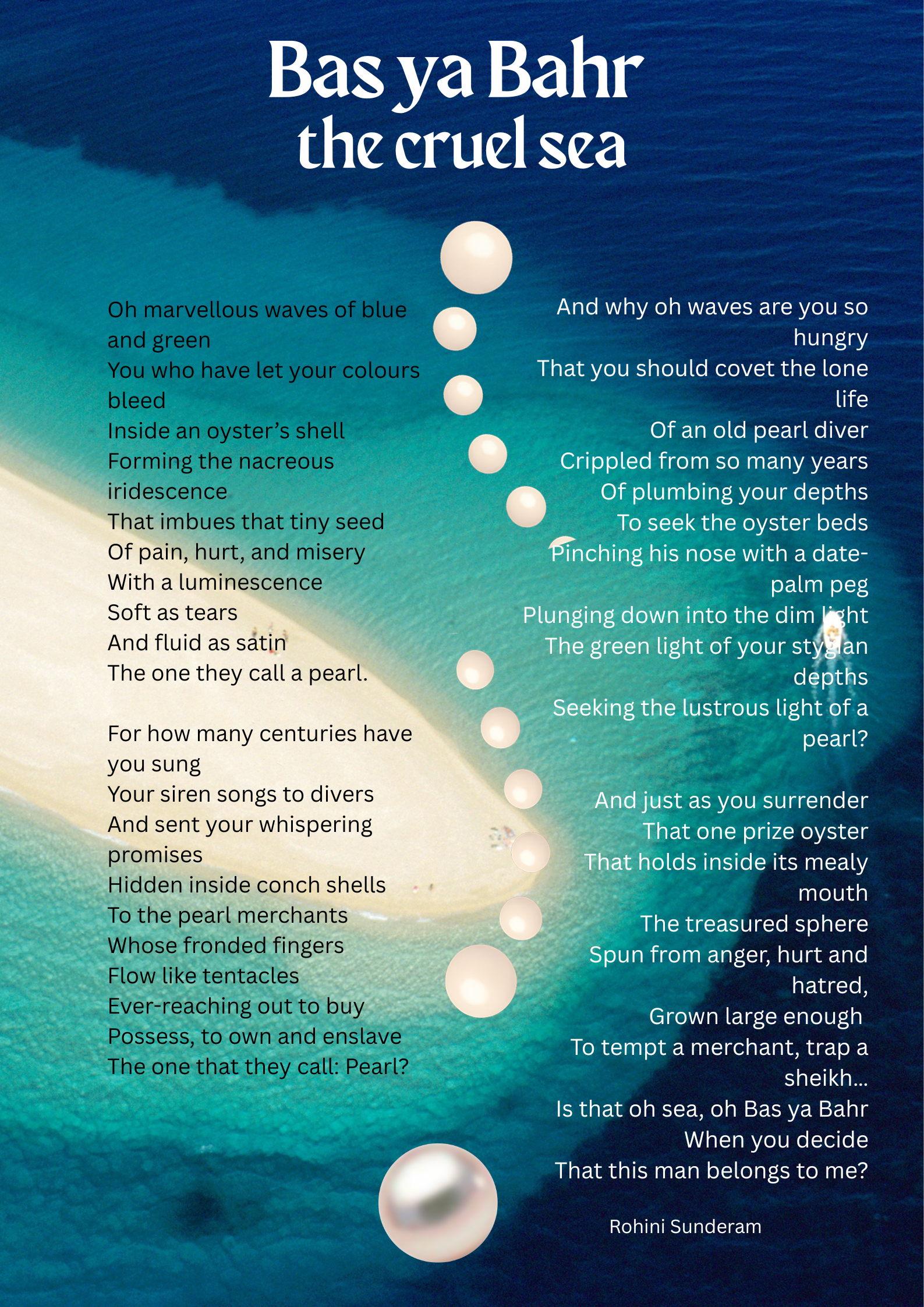
As often happens these days I was searching for another poem when I came upon this one. I thought I’d give it a visual interpretation. I hope it works.
Let me know what you think…
In Bahrain and other parts of the Arabian Gulf, the Pearl divers went out to sea to look for pearls in, what were at the time exceedingly the rich oyster beds located in and around the gulf. It was a hard life and dangerous and much lore surrounded the profession and the songs. This traditional music, known as fidjeri, is an age-old repertory of vocal music sung by the pearl divers of Bahrain, Kuwait and Qatar. The Nahhaam, or pearl diver singers, were backed by a chorus of singers and clappers accompanied by the Mirwas – a small double-sided drum – and the jahlah – a clay pot.
In 1972, a film by Kuwaiti Khalid Al Siddiq, titled The Cruel Sea – better known by its Arabic title Bas Ya Bahr – related an artistic representation of the pre-oil life of the pearl divers. It proved to be a masterpiece and tells the story of a crippled old pearl diver who tries to prevent his son from taking up the trade because it is so fraught with danger, but the son is in love with a girl from a wealthy family and needs to make money to marry her. This poem hints at the story and the theme of the film, the sea: treacherous, unmovable, unchanged, eternal and ultimately cruel.
The so-called winter in Calcutta pushed the mercury to 25C. One moment the wind was warm, heavy with humidity blasting up from the Bay of Bengal carrying with it a reminder that this had all once been a swampy rainforest. The next moment it sent us a chill message from the faraway Himalayas, it’s still winter.
My belly was large, bulbous, weighed down by the baby. I’d taken to wrapping a shawl around my waist to help support my stomach. The kicks and rolls, the tiny fist jabbing inside me had gone from a tickle that made me giggle to a physical pain. “Your previous caesarean scars are stretching as it’s growing,” the doctor had explained. 1980 was a time when an ultrasound just confirmed that the baby was okay. We neither knew nor cared about gender.
The ‘IT’ was the baby. The doctor’s face was implacable. Bedside manners hadn’t become fashionable yet. “Rest”, he advised me. His expression was stern the lines drawn down from his spectacles to his jowls were twin wrinkles, pushed deeper by bulbous cheeks. ‘Too much macher-jhol* and rice’ I thought. Back then patients didn’t make cheeky comments to their doctors.
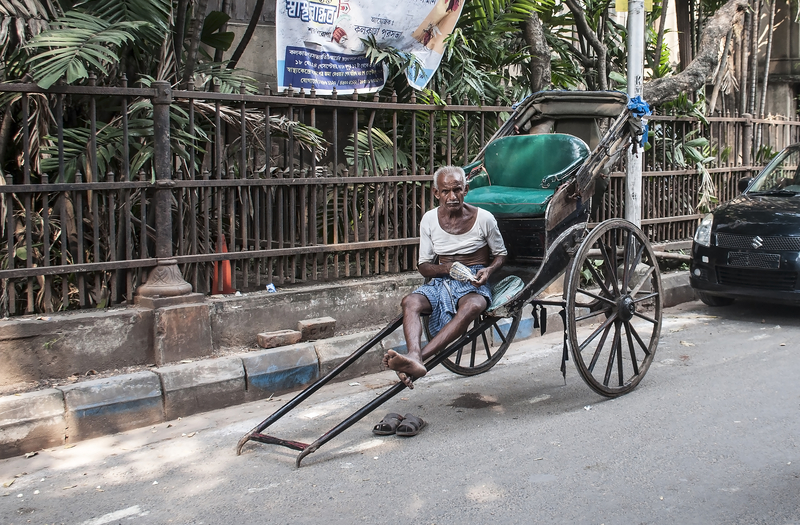
When I limped out onto the street, I was close to tears because getting a cycle rickshaw to take me home at mid-day would be impossible. It was too far to walk and too close for a taxi to bother. I looked around and saw an old hand pulled rickshaw runner. He jangled his single large bell, that looked like the tiny ghungroo bells worn by classical dancers on their ankles. I hadn’t taken a hand pulled rickshaw until then, it seemed so demeaning to them. Reminders of the British Raj, still so omnipresent in Calcutta, were interrupted by a sharp twinge of pain. I grimaced.
He smiled, waving a fly from his grizzled face. “Daughter, where do you want to go?”
“BBD Bagh,” I said, “How much?”
He quoted a price. I readily agreed and clambered onto the rickshaw, landing with a thump on the seat as I thanked him profusely.
“I thank you,” he countered, “Not many people take our rickshaws these days, it’s my only livelihood. And many of us must give up the job.” He panted. His slow pace had picked up to a steady jog, “we barely make enough for our daily food.”
I watched his thin sinewy legs as they pumped up and down. His feet were bare and thickly calloused from years of hitting a hot tarmac.
Guilt, like a monsoon shower, washed over me when he stopped in front of my building. I wanted to make it up to him. “Where do you get your rickshaw bell?”
He laughed. “Why?”
“I want it as a souvenir,” I said.
“You can take this one,” he offered.
“How will you call your fares?” Tears of remorse pricked my eyes. “What had I done?”
“I have an extra one,” he said, pulling up the seat where I’d been sitting. Under the worn red leather cushion, he had stored his meagre belongings, an almost threadbare grey blanket, rubber slippers, an extra loincloth, and striped underwear. He pulled out the grey, aluminium bell with a leather thong strung through the hoop at the top.
“How much?” I asked. A cool breeze washed past me, a benediction, for my good deed? It cooled the perspiration around my neck.
He laughed, a few teeth were missing, the rest stained red-black with betel juice. His dark sun beaten face and grey beard were almost demonic, but his jet eyes were gentle and the crow’s feet crinkling in amusement made me smile.
“Whatever is easy for you madam. I bought it a long time ago.”
I handed him thirty rupees, “for the fare and the bell.”
“Madam, it’s too much.” His jet eyes glistened with emotion.
“From the baby and me,” I whispered, “Give me a blessing.”
“Of course, of course”, he said coughing up phlegm which he spat into the street. That was Calcutta. “Live long, daughter, bless you and the baby.”
‘May it be normal,’ I say in my mind. It’s the closest I’ve come to praying in nearly twenty years.
I put the bell into my handbag which I slung over my shoulder. Then, holding my belly under my shawl, I climbed the steps to the door, pushed past it into the cool dark foyer. I pressed the button for the old black wrought-iron lift that clanked on its way down.
I felt lightheaded when I got home and lay down as the various helpers got me water, tea, and turned on the fan.
When I awoke, I was being rushed on a stretcher past green curtains. My doctor and an elderly lady anaesthesiologist were rushing beside me. I wanted to ask, “what happened?” but my tongue was stuck to my palate, and I couldn’t get any words out. I knew where I was. Had I fainted? Where was my husband? I was in pain; his hand was on my arm. “It’s all ok”. His voice was husky.
I slept again. Jagged neon lights slashed my abdomen. Pethidine. Is my baby ok? In the early morning dark, tears burnt my eyes. Until the previous afternoon when I bought the rickshaw puller’s bell, I had abandoned God and prayer.
I tried to say, “Our Father…” but it stuck in my throat. I demanded of Him, “Give me my baby whole and complete, and I’ll return.” It was a promise. A challenge. Not a prayer.
“Your baby,” the nurse said, and I took the little girl in my arms. She had a shock of thick black soft hair. I put her to my breast, she sucked hard at my nipple. Her will to live hurt. I examined her fingers, toes, face. She was perfect.
I reached in my handbag for a tissue and felt the rickshaw puller’s bell, “Your birthday blessing,” I whispered.
A pink dawn cracked the sky. I looked heavenward, “Thank you.”
Onto the literary scene in the Tri-City area in British Columbia
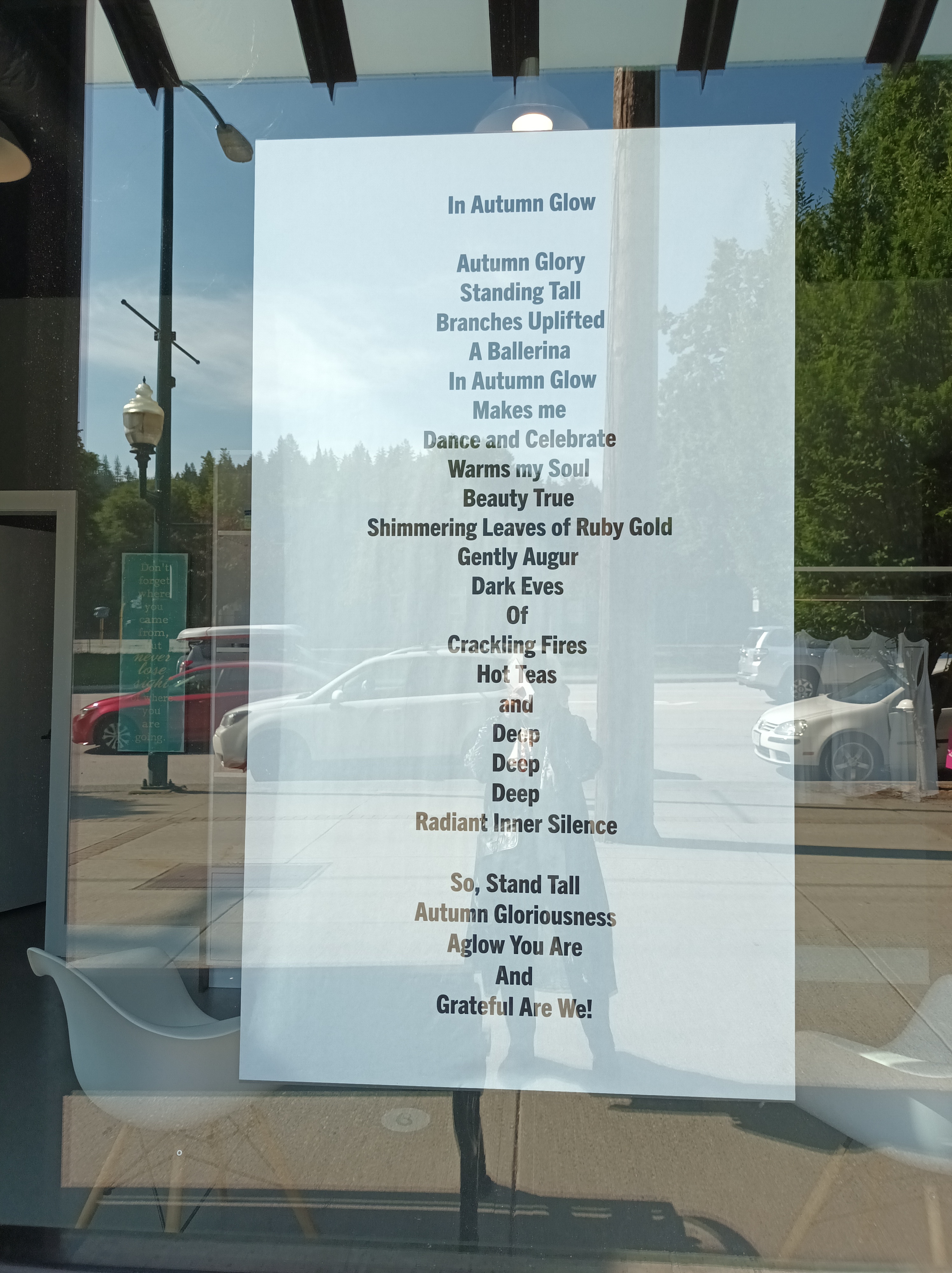
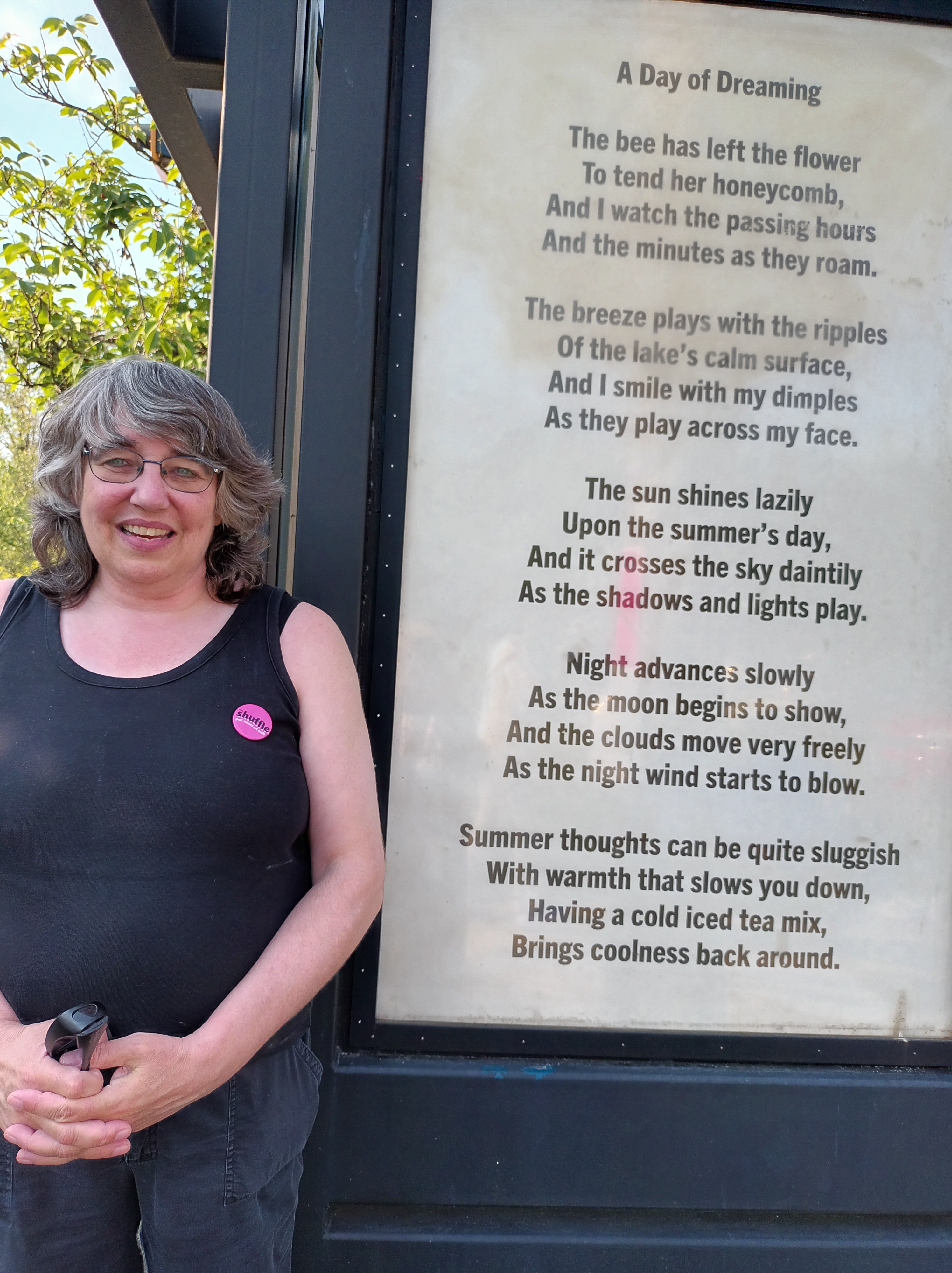
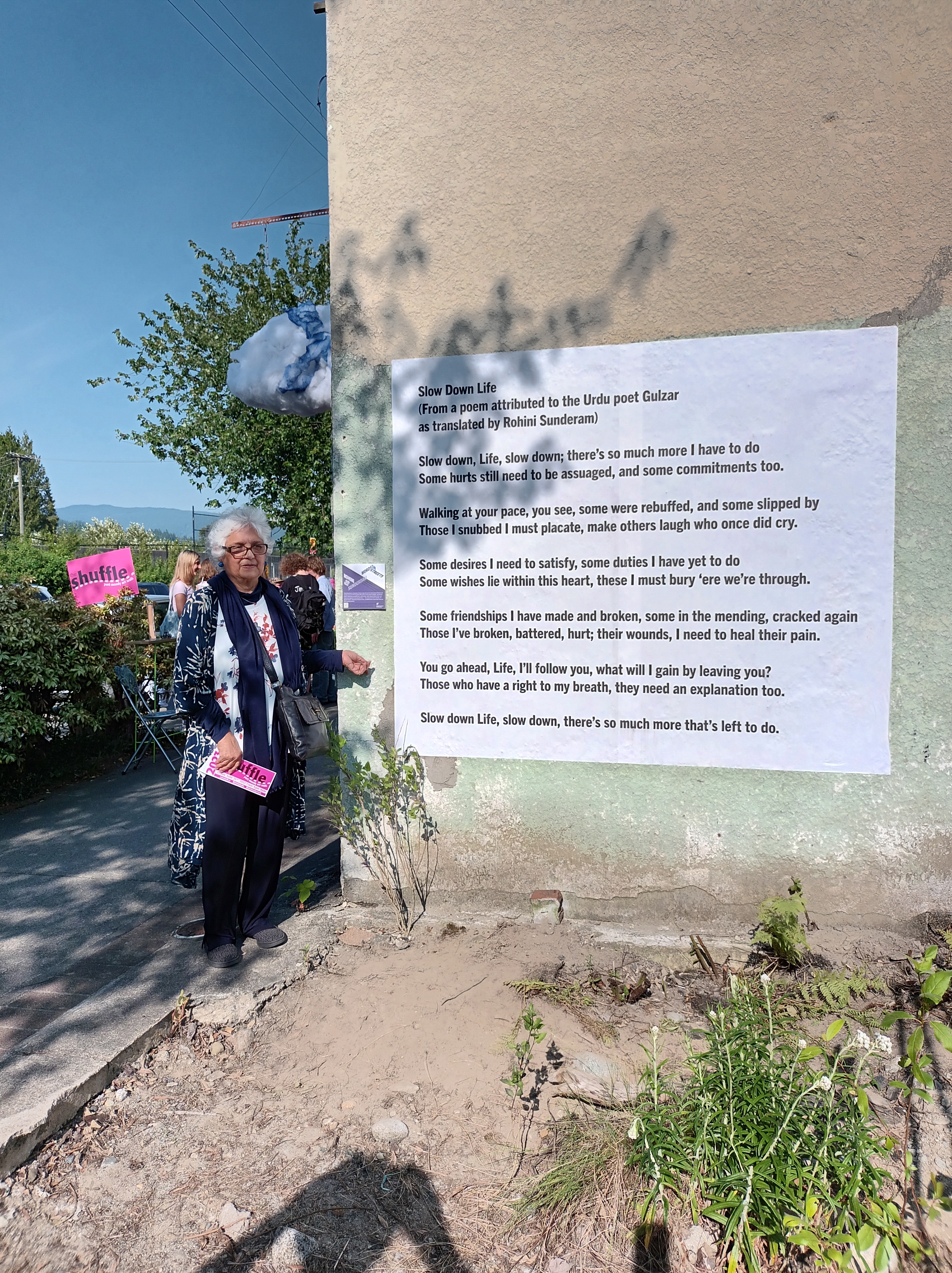
My first venture into the literary community in the Tri-City areas began on June 23rd, 2023. Close enough to the summer solstice. It was a warm and sunny day and St. Johns St in Port Moody was a-buzz! Pink flags marked out Shuffle venues. Guides and helpers in pink t-shirts with buttons were around and very helpful. The whole area had a bright carnival atmosphere. And, no wonder, I believe there were around 100 participants!
I arrived a little after four in the afternoon on June 23rd, and the feeling of being in the midst of a gala event immediately struck me. I stepped off the bus almost right in front of Barre Fitness Studio, hoping to meet the lively @Carmy Stubbs, but the lady at the reception didn’t know where the reading was being held.
By now, I was close to the recordings of @Pandora Ballard’s poetry, but I couldn’t find them! Fortunately, a couple of Shuffle Guides, who were shuffling by, stopped and showed me where the recording boxes were mounted. I may not have found them otherwise! To be honest, with all the hustle and bustle around, it was hard to hear.
I then rushed down to Clarke St. (no more shuffling, I was meeting friends near my exhibit, and they’d been sending frantic messages because they thought they’d lost me! Phone-stuck-in-handbag syndrome). And my what fun! Clarke St was the busiest little spot – it was like a street fair; it was a street fair! There were kiosks, and tables with art, crafts, and even a poet who offered poetry on the spot! I wasn’t able to speak to him.
A little beyond my exhibit I saw Karen Hein’s kiosk with her poetry and had the wonderful opportunity of meeting her!
Now, to my little footprint in the sands of Port Moody, plastered onto a wall on the side of Grit Studio and café that’s where it was. In the midst of all that was hectic, my translation of Gulzar’s Ahista Chal Zindagi – Slow down, Life, slow down…. And oh, the difference to me.


 FictionPals