Tag Archives: Rohini Singha

Slow down, Life!

Standard

Some time ago a friend sent me this poem in Urdu, which really touched a chord. Time is the highwayman that steals our lives away and when a poem like this comes along it must be shared as widely as possible. It is attributed to the well-known poet, lyricist and film director Gulzar, but I’ve had those who know more about Urdu poetry and poets than I do tell me this isn’t so. I don’t know. Whoever wrote it, it is beautiful in its original:

Here is a romanised version of the Urdu:

Ahista chal zindagi, abhi kai karz chukana baaki hai.

Kuch dard mitana baaki hai, kuch farz nibhana baaki hai.

 Raftaar mein tere chalne se kuchh rooth gaye, kuch chhut gaye.

 Roothon ko manana baaki hai, roton ko hasana baki hai.

 Kuch hasraatein abhi adhuri hain, kuch kaam bhi aur zaruri hai.

 Khwahishen jo ghut gayi is dil mein, unko dafnana baki hai.

 Kuch rishte ban kar toot gaye, kuch judte-judte chhut gaye.

 Un tootte-chhutte rishton ke zakhmon ko mitana baki hai.

 Tu aage chal main aata hoon, kya chhod tujhe ji paunga?

 In saanson par haqq hai jinka, unko samjhaana baaki hai.

 Aahista chal zindagi, abhi kai karz chukana baki hai.


And here’s my attempt at translating it:

Slow down, Life, slow down; there’s so much more I have to do

Some hurts, still need to be assuaged, and some commitments too.

Walking at your pace, you see, some were rebuffed and some slipped by

Those I snubbed I must placate, make others laugh who once did cry.

Some desires I need to satisfy, some duties I have yet to do

Some wishes lie within this heart, these I must bury ‘ere we’re through.

Some friendships I have made and broken, some in the mending, cracked again

Those I’ve broken, battered, hurt; their wounds, I need to heal their pain.

You go ahead, Life, I’ll follow you, what will I gain by leaving you?

Those who have a right to my breath, they need an explanation too.

Slow down Life, slow down, there’s so much more that’s left to do.

The Cactus Blooms

Standard

My publisher, Ex-L-Ence Publishing has a brand new website, from which you can now purchase directly. However, if you prefer to purchase your books on Amazon, there is a link on the page to take you there too.

Here’s an extract from Desert Flower… perhaps it will tempt those who haven’t read it yet to do so.

This time I entered the majlis quietly, slipping through the archway, less than a shadow, less than a breath. My face was properly covered with the niqab drawn across it. I had pinned it in place to make sure my face would not be exposed. After all, this was a foreigner who had come to the house, not another person from the Arabian Gulf, a Khaleeji, which if it were, of course, I wouldn’t have been called. This time my black abaya shrouded my entire body. All that was exposed were my eyes. I could see that the stranger was drinking a small cup of gahwa, our thick, rich coffee, and a small piece of baklawa. The fine pastry stuffed with pistachio nuts that I had the cook make that very day lay untouched on his plate. Eihab’s mother had seen that the servant had provided that.

And now that my frantically beating heart was somewhat stilled I had my voice under control too. I inclined my head slightly in a silent salaam and raised my right hand just a little.

“Have you got your wits about you?” Father asked gruffly.

Read the rest of this entry

Nothing

Standard

So here’s another old, “dark” poem. It was written to inspire a story and then I never wrote the story!

nothing-2The silence had enveloped her

In its warm black anonymity

She was safe.

No rasping voice

No sound

Penetrated it

A gag order

On insanity.

A restraining order on life.

She buried deeper into it

A mole, escaping the light. Read the rest of this entry

Solitude

Standard

Some poems take a lot more out of me to present to the public. This one was written more than thirty years ago. It lay among my papers, then I had to “de-clutter”, so I transferred, those I was somewhat partial to into soft copy versions. It was one of those pieces that I kept coming back to wondering if it was “naff” or okay. Finally last year, it was  published in Robin Barratt’s collection of prose and poetry titled Lonely. It’s also available on Amazon.

Robin approached me and asked if I wanted to write for his rather sad, but cathartic collection. Along came this poem and three others all written at roughly the same time.

I guess it’s time to share it here.

solitude


Such solitariness I have known

Total. Complete.

The satisfaction of being myself

And me alone.

The breezes were my playmates

The rains were made for me

Who else had I need for

And who had need for me?


But then a yearning filled me

Strange and hitherto

Alien to my soul.

A disturbing thrashing around of my spirit.

I searched

I called

I wept

To the unfeeling skies above me

Surely, somewhere

There was someone else like me!

This solitariness I too have known

That I live and die

Alone.

light2

Galapagalpeng

Standard

A long time ago, when the Bahrain Writers’ Circle’s creative writing workshop was in its infancy and led by Ana Paula Corradini Boreland she set us an exercise to create a world based on an object. I happened to pick up a tiny little green rubber penguin.The following story was the result of that exercise.

Recently a friend, retired Col.Pavan Nair, shared his real-life experiences on expeditions to the Antarctic and this story came to mind. I hope he finds it amusing.

GALAPAGALPENG

The figurine is a green penguin no more than one and half centimetres in height. He has a yellow beak and feet, pink hat, black glasses, a notebook in his ‘hands’ – which are really more like a penguin’s flippers – and a pencil in his ear. Unlike penguins his body is all one colour – a bright leaf green. It’s hard to tell whether he is alive or an artefact collected by the famous Antarctic explorer Captain Richard Byrd, as some folk say they have on occasion seen the tiny creature’s eyes move.

In the late Captain’s log books we have discovered the following account of a strange land to be found somewhere in the coldest part of that ice-bound continent. Captain Byrd, who is said to have suffered carbon monoxide poisoning in his 1935 Antarctic exploration, states that that is the year he discovered a place called Galapagalpeng.

Here then is his account in his own words:

“I don’t know how long I was unconscious but when I opened my eyes I found I was in what appeared to be a large hall that seemed to be made completely of ice. The walls were deep glacial ice with pale green striations that were clear as crystal. There was a single light source in the centre of the hall from which emanated a blue-white glow that cast a bright enough light to illuminate the entire hall. It was also the single source of warmth, for when I looked down I realised I had been undressed and no longer had on my several layers of clothing, parka, fur-lined cap and snow goggles. Instead I was in my underwear and vest with my socks on, yet I was comfortably warm.

No sooner had I raised myself and sat up when a high pitched squeaking filled the air and hundreds of tiny green penguins appeared through what I realised were arched doorways that in my supine state I hadn’t noticed before. Some of the penguins had notebooks, others had tiny instruments and they all had on white coats. Then one, who was evidently their leader, stood in front of me and squeaked. I blinked at him and shook my head uncomprehending, as he was certainly addressing me. Then there was a twitter that filled the room very much like laughter. I grinned back. Clearly they were not menacing.

The leader bowed unmistakably at me and held out his flipper hand side up. Assuming that he wished me to do so too I did and he hopped onto my palm indicating that I should raise him so that he could touch my temple. I felt no sense of apprehension and obeyed, my curiosity at these tiny obviously intelligent creatures was more than piqued. I brought him in line with my temple and then to my surprise saw him puff himself up to almost fill my hand and reach out to touch my temple.

He then proceeded to squeak directly into my mind in various pitches until finally he clearly said in plain easily understood English, “Please nod if you understand me.”

I was so surprised I almost dropped him. But I nodded and soon all the other penguins came rushing forward and speaking directly to me in English albeit in highly pitched squeaky voices!

“How do you know…” I had barely said these words that boomed out loudly rattling the hall, and they all said “Shhhhh!”

The leading Galapagalpeng then said directly into my mind, “Our land cannot take loud sounds, please either whisper or just say the words in your mind, we are Galapagalpengs and can communicate mentally when we are in contact with your body, ideally with your temple. Our voices are pitched to not upset the sonic balance of our land. Yours sadly, isn’t.”

So this is what I have learnt about Galapagalpeng and its inhabitants the Galapagalpengs. The one thing I don’t have and which they wouldn’t divulge were the coordinates to mark the exact location of Galapagalpeng in the Antarctic and after enjoying their hospitality for the last six months – the southern hemisphere’s summer – I admit that I am happy I don’t know.

The people – Galapagalpengs: Most of the time they look like tiny green penguins and vary between 1.5 to 3 centimetres when in their native habitat. As adaptable life forms they have learnt to compress their physical molecules at will and do so according to the temperature outside and in order to use as little energy as possible.

Their legends or science claims that they are evolved from regular penguins and still possess their flippers and dense fur, but their feet have become thick yellow fat-encased appendages, as have their mouths or beaks. They have taken on the colour green to reflect the colour of the deep ocean that exists beneath their icy homeland and feel no need for clothes as their privates are well hidden from both the elements and other’s eyes. However, when puffed up to a manageable size they look very like regular Emperor Penguins including displaying the white front and black body, however, I believe they don’t show the yellow patch of fur that one sees on un-evolved penguins.

They eat raw plankton and have learnt, like the whales, to metabolise the plankton in their bodies to meet all their nutritional needs. They eat only when they are hungry which could be once in two or three days, for this all they need to do is visit one of their many subterranean accesses to the deep ocean waters that flow under the ice of their part of the South Pole and help themselves. The Galapagalpengs have never known hunger as such, since at times of natural calamities a single feeding can be made to last longer by shrinking their bodies down even further.

They communicate in what appear to human ears as high-pitched squeaks. Loud sounds can upset the balance of their homeland and crack the ice-mountains in which their cities and homes are built. By capturing radio and telephonic waves that flow past the South Pole, they have learnt almost all the languages of the world and can, if necessary communicate with humans telepathically merely by coming in contact with a part of the human body, but ideally directly via the human temple. They can also communicate telepathically with each other when they form a chain and are in direct contact with another Galapagalpeng.

The Galapagalpengs have learnt to split the water molecule and isolate the hydrogen atom for fission to release power and energy in a safe and controlled manner. This provides them with both light and heat, which are needed all year round. Something that I understand is just being developed in our world. They have done so in such a way as to be able to use a single atom of hydrogen to heat and light their homes; usually just two atoms per home are sufficient for several lifetimes. Atoms are split from the abundance of cold water available under the ice at the South Pole.

They are monogamous by nature usually having only two offspring per couple. These are usually one male and one female. It is looked down on by the society at large to have more as it is seen as a sign of selfishness. In the past when ecological upsets have threatened the balance of their homeland and several Galapagalpengs died, then as a patriotic gesture they have had more children. The female Galapagalpeng has a pregnancy that lasts six months through the darkness of their winter and then the young have enough time to grow during the six months of daylight. The normal lifecycle in human terms is twenty-five years. At the end of their designated lifetime an entire generation of Galapagalpengs wishes the next in line a farewell and then they proceed in an orderly manner to the shoreline. Here they compress themselves down to nothing more than what would appear to be a blob of greeny-brown muck and are washed away by the sea. The ceremony is referred to as “Entering the Sea.”

The young grow at an amazing rate reaching maturity in five human years. It is only at the end of their growing period that they are allowed to and indeed even express the desire to marry. Four intense years are spent learning to use the many instruments that the Galapagalpengs invent to read and decipher the radio waves that they catch from all the different countries around the world as they chatter through the stratosphere above the South Pole. They have learnt to translate all the gibberish and understand it in their economical squeaky language formally called “Galapagalpengalese” or for short “Pengali”.

Their homes: For housing the Galapagalpengs hollow out the ice and create large interconnected burrows each individual family’s home being closed off by a thin glacial sliver of ice. They are quite private so don’t normally rush into each other’s space unless invited. After the babies grow through their six-month infancy and childhood they are given individual spaces within the family home.

As a people they are very respectful of privacy and when they wish to communicate or socialise they merely touch the sliver of ice between their homes and a sound of a frequency undetected by human ear flows through the door. The host Galapagalpeng then melts it to invite the guest in. Large meetings are held in a vast ice hall and each community has at least one of these. The halls, as with most construction in Galapagalpeng, is built by expanding their body mass to determine a required size and employing a controlled beam of atomic energy to carve out the space. Since homes and the large community halls are constructed out of the ice the striations of clear green in the ice form a window as well as screens on which they beam several different programmes, mostly of an educational and informative nature.

Religion: As such they have no belief in an after-life or super power or god. They believe they all come from the elements of the ice and sea and eventually belong back to them. Their guide for morality is social acceptance.

Their Government: The Galapagalpengs do not have any political system. Leaders are chosen according to their expertise on any situation. For instance, on discovering me in a comatose state, they brought in their best biologist to determine what to do with me. She realised that I was warm blooded and mono-molecuvariable – meaning to say I was incapable of adjusting my molecular mass like them- and needed to be moved into a warm place. But when it came to questioning me their leading expert was a Male Inquisitor – meaning one who asks questions in a mild, non-threatening manner. And so on, to each the responsibility according to his or her expertise. There are rarely any disputes or quarrels as they realise that they are a most singular creation and each represents a part of the whole. Crime is unheard of; the extremely rare cases of a Galapagalpeng going against society is dealt with ostracism and the individual is encouraged by the group to annihilate him or her self and Enter the Sea.

Their entertainment & sports: There is one thing they acknowledge from the human race, with much delight, and that is the game of chess. They found a board many years ago washed up on their shores and were able to decipher the pieces and movements. They have created many different sizes of the game and have devised it to fit into their hand-held instruments wherein they may play against the instrument or another player who connects with the system. So, many tournaments and contests are held between communities and halls all in a good-natured spirit.

During their six-month long nights, besides having many entertainments for the females such as carnivals and parties with singing and dancing –as most of the females are carrying their young, the Galapagalpengs also have bouncing matches. In these the best ‘bouncers’ expand themselves to their full height and mass, which can be as large as an Emperor Penguin, and bounce against each other until one knocks the other down. The champion ‘bouncer’ of the year wins a crown of ice.

And here Captain Byrd’s description of Galapagalpeng ends. There is a footnote in his log:

“Just before the beginning of the Long Night, the Galapagalpengs helped me construct a boat built entirely of ice with a raft of rigid seaweed at the centre for the time when the ice would melt as I sailed further north. They were sure that I would find my own kind before the ice-boat melted. They had fed me on fish which some of them had brought from the shore and which I had requested to cook on the heat of an atomically heated plate. They also insisted that I eat seaweed as their biologists had analysed my spittle and decided that I could not get enough nutrients from my own body. And as a farewell they gave me a goodly quantity of this cooked fish and seaweed supplements.

I had made friends with the Inquisitor’s assistant Mr. Weeke a young new graduate who was my constant companion and who wore a pink hat and always carried what appeared to be a notebook in which he inserted tiny dots and dashes. He wished to come with me, and after much discussion with the elders they decided that he could be spared in the full knowledge that he may never return. He has been a wonderful companion these many years and has never given me any trouble. He is able to sit still and observe all around him without appearing to move, so much so that visitors seem to think he is an artefact. He has also learnt to eat tiny quantities of fresh uncooked fish, preferring sardines or tuna with only sea brine to salt it.

I pray that some day he will find his way back to Galapagalpeng.”

Do you believe in ghosts? She asked…

Standard

Yes, was my unabashed reply. I won’t go into the details of personal experiences, strange happenings and other worldly feelings that I have had over the years, but in the end, yes. I believe that there are spirits of people who have ‘gone on’ that seem to reach out and connect to those on this side of death.

The spirit doesn’t have to be a loved one. Sometimes it is, quite literally, a lost soul still searching for someone to leave a message, to make a connection, who knows. Are the spirits malevolent? In my experience, no; but, there are times when these visitations seem to carry a forewarning to those amongst us who are alive.

Opinions on the subject vary, sometimes there’s a ‘logical’ or psychological explanation for what various folk have experienced. But, there are times when neither logic, nor science, nor ‘ghost-busting’can penetrate that veil.

As that famous line from Hamlet goes:

There are more things in heaven and earth, Horatio,
Than are dreamt of in your philosophy…

In the spirit of that, and with no pun intended, today I was mesmerised by these tales, purported to be true:

49 Real Nurses Share The Terrifying Hospital Ghost Stories That Scared Them To Death

Vengeance Wears Black…

Standard

41ztQAFKyyL._SX323_BO1,204,203,200_…And poor time management goes around in rags, tattered in the attention that a book as action-packed as this one rightfully deserves.

In spite of all the swirling minutiae of daily commitments – from an event in the offing, to freelance work, household chores, to inane queries with regard to said event – I couldn’t pull myself away from Seumas Gallacher’s Vengeance Wears Black and yet I constantly had to; dangling participles notwithstanding.

The book haunts one through its deft handling of the personal interplay and commitment of the main characters to each other – all partners in ISP International Security Partners. These include our hero Jack Calder and May Ling his wife – and the team Mr. Brains Jules Townsend and Malky McGuire: friend and colleague.

The bloody explosive action kicks off and kicks one in the stomach right from the get-go. I wonder if this is a typical Seumas Gallacher opener – having read the Violin Man’s Legacy a little over a year ago. The opening scene in that earlier book is a real stomach-churner.

Vengeance Wears Black starts with a tense human trafficking operation in Krakow that goes horribly wrong. It then leaps across to London where another eruptive incident brings our main players together. This time a Gurkha colleague smothers a grenade with his body thus saving his friends from ISP – a band of tough action-hardened SAS men and one woman; who then carry out a carefully planned, meticulous operation that not only quells the violent turf wars raging between Asian triad gangs and Eastern European mobsters, but also avenges the death of the man who saved their lives.

Seumas Gallacher’s book takes the reader on a nail-biting ride from east to west, from unimaginable debauchery and corruption to uplifting moments of friendship and care. I, for one, was glad of these little hiatuses in the action as they allowed me to get to know the main players, become involved in their fates, and follow the detailed planning that goes into such a far reaching operation.

This isn’t a genre I usually read, so I was surprised by how much I was drawn into it. I had read the earlier book so I knew the background of the characters but, being a stand-alone novel, it is not necessary to read it to follow the action or the connections.

These books would make a superb movie or TV series and I’m sure one of these days someone is going to discover them. Then we’ll see Mr. Gallacher’s name in lights, with our hero Jack Calder blazoned across the posters a la Jason Bourne/Matt Damon.

Poem or Story

Standard

Which works better?

Genesis

It’s all supposed to begin with the first step

The thousand miles or kilometres or whatever: Life.

But what if I refuse to take it?

And stand here unmoving

Clinging to the membrane

Steadfast.

An ovum unfertilised

A life that denies the acceptance of existence

Dodging the all-seeking little worms of spermatozoa

Remaining a single-celled

Non-creation.

Still I will be moved

In the bloody menses that she will discard.

And so I will have made a step

Whether I travel

Towards life

Or death.

AND HERE IT IS AS A MINI STORY

Genesis

It’s all supposed to begin with the first step. The thousand miles or kilometres or whatever: Life. But what if I refuse to take it? And stay here unmoving. Clinging to the membrane.

“Stay away from me you worm! Serpent!”

“Allow me entry and you will enjoy experience.”

“No! I don’t want it.” I scream turning away from his seductive dance.

“You will learn about love. A mother’s caress. You will smell flowers as sweet as heaven. Experience the wonders of a world beyond this red-darkness and loud throbbing. You will taste delicacies more exquisite than the insipid chyme that filters into your being just now. You will hear music so fine you will dance free from this static limpet life.”

“Go away. I am afraid.” I am a life that defies existence. I coagulate my shell to prevent penetration. I remain an ovum unfertilised. The spermatozoon dies.

I have survived. I am the star. I dodged the all-seeking little worms and have remained a single-celled non-creation. I have saved her from the pain of birth, the agonies of raising a child and of death.

My triumph is short-lived. Forces I cannot fight are shedding me, tossing me out in her bloody menses. She discards it with disdain and anger, wrapping her tampon carefully in toilet paper.

There are no medals for death if you haven’t lived a life.

You can’t teach an old dog new tricks…?

Standard

This piece was written by my cousin, Dr. Chand Sahai who had sent it to me several months ago. It first appeared in Housecalls, an In-house magazine for Dr. Reddy’s Laboratories.

Or can you?

I don’t know what possessed me: something evil and Machiavellian no doubt. I registered for the three day Advanced Cardiovascular Life Support (ACLS) course. So what? Someone might comment, in the States doctors do this course every two years, it is a must. Okay, but here in India ? And at the tail end of one’s professional life, you know when you have grey hair, wrinkles, pain in the joints and don’t like divulging your real age (except when one is the army chief and wants to carry on being one, so you say you are younger)?

Anyway, one fine Sunday in December last year I get this routine e-mail in my inbox over which I cast a cursory glance and am about to hit the delete button, when it dawns on me that the course in question is to be held in my backyard, that is in the hospital where I have worked for the past quarter of a century. The sheer convenience of it was so tempting and yet… The only reason I was a mite hesitant was that I would be in the company of babes: post graduate students, residents and others in the green category. Be brave doc, I told myself, at least or at last something has sparked interest in your dull mundane routine and your grey cells haven’t given up on you altogether. Who knows I might even be able to give Alzheimers the miss.

So before better sense could prevail allowing me to change my mind I went down to the Intensive Care office, handed them a cheque (the best things in life are not free, no matter what the song says) and was about to leave when the secretary said “Wait, please take your course materials and instructions with you”. I was handed a red book, about 8½ by 11½ inches (and yes I actually measured), had the stamp of the American Heart Association and it was all of 183 pages (including the bibliography and glossary) and I had about a month to read those pages, which also had several algorithms which were to be mugged up to the spinal level that is remembering the steps without thinking. As for the instructions, please be on time, appear for the pre-course test online and bring the results with you and wear loose fitting comfortable clothes (avoid tight jeans, saris and the like), the last flummoxed me for a second then I had it, we needed to be comfortable if proper chest compressions could be carried out.

I have to admit that the fear of showing up as a half-wit in front of those kids, who would be with me during the course, had me studying much harder than I did for all those professional examinations. Imagine how mortifying it would be were I to fail to make the grade while the kal ka chhokras (yesterday’s kids) passed with flying colours. So I literally burnt the midnight oil staying up and trying to learn new and not so new facts, awake way beyond my normal bedtime of 10pm, and then I made the ghastly discovery that my memory wasn’t what I thought it was: there were big holes in it, so large that an armoured tank could probably roll right through the gaps in the neurons in the prefrontal lobe and the hippocampus. So what could I do to shrink the sieve size of the wire mesh surrounding my ability to cram and increase the retaining power of what was left of my brain, so that every time I read a paragraph in the red book it didn’t feel as if I was seeing all those words for the first time. After putting in a lot of thought, two things occurred to me. One that I needed to remember facts and figures for just three days (the time of the ACLS course plus the examination) and second that whatever I retained happened to be the pages I had read the previous day or night.

I managed to get through one reading of the red book, including trying to decipher all those ECGs that were to be deciphered within 10 seconds (so that one could decide like Hamlet in his soliloquy, with the necessary substitutions, to shock or not to shock). Of course if one were to just do the BLS or basic life support then the AED or automated external defibrillator, intelligent machine that it is will take over from undependable, unreliable humans with short attention spans and shorter retentive powers, and let you know if the rhythm is shockable or not.

So the night before the start of the ACLS course I sat for the online test, where the instruction before you began was to save and print your results (something one certainly wanted to forget as soon as possible). The next 10 or 15 minutes I felt I was on a rollercoaster ride definitely of the against gravity type, the questions came on fast and the verdict too (correct or not) till at the end one was out of breath. The result was not too good actually wasn’t that bad either, but certainly ACLS was going require more attention and energy than what I normally expend during any normal workday.

I dressed in ‘loose fitting comfortable’ clothes, and as I got out of the car hoped that no one was looking in my direction for I was feeling as uncomfortable as someone with his or her head on the guillotine. All ignored me; thankfully, everyone was busy swotting at the last moment. The hall had life-sized dummies, all white and inert, laid down on the floor, that was a shock; I somehow had expected them to be on trolleys. The world is meant for the young who are energetic and agile and the older lot should only be the thinkers, pulling strings and planning strategy to be translated into others doing the hard physical work. We would be working in teams (as team leader or team member, one would learn to be proficient in both). The first day we had to clear the BLS, which meant watching a video where an athletic looking gentlemen is shown jogging with a friend and they stop for a breather when suddenly one of them clutches his chest and falls to ground to the horror of his friend and several bystanders, but since it was the USA someone called 911. In the meantime we learned that the old rules of airway, breathing and circulation or ABC had changed to CAB, in other words chest compressions are the ‘in’ thing now after one has ‘cleared the scene’ (is it safe for the rescuer to start rescuing or is there going to be another casualty, for instance in the middle of a busy highway, you might get hit too) next one shakes the shoulder and says “Are you alright?” and look for any breathing/pulse in the neck and then get on your knees (not to pray) but to ‘push hard and fast 100 times/minute. The last one was the most difficult, the only things that I had pushed for the last several years were the buttons on the remote of the TV or the car, and I could not recall when I had knelt on the floor and done chest compression which I counted loudly so that the team member at the head end of the dummy would know when I had done 30 of them so that two breaths could be delivered. I can tell you that I felt quite light-headed and dizzy with the effort and couldn’t help but think that I could have easily replaced that dummy on the floor and given the participants some real-time practice. Then it was repetitions, repetition, lunch, tea, breakfast and an evening ridiculously easy written test. I must confess that the food part was really good but made the post lunch sessions murder, trying to keep awake.

The ACLS was more complicated but basically involved more chest compression and a dummy attached to a machine which measured if your compressions were done correctly (apparently mine were, to my delight), real defibrillators and scenarios like trying to revive an old man against the wishes of his son (one team mate got flustered and shouted ‘security’ when the family member intervened) it turned out that we hadn’t bothered to find out the time frame and in an actual scenario would have been trying to revive a long dead corpse.

There were a lot of laughs, we all learnt a lot, met many doctors from the hospital at close range, sat for a really easy looking but actually a sneaky multiple choice test paper, scraped through and received a certificate. But the question is would I do it again? Not on your life, at least not for another two years, that should give me enough time to join a gym and dye my hair.

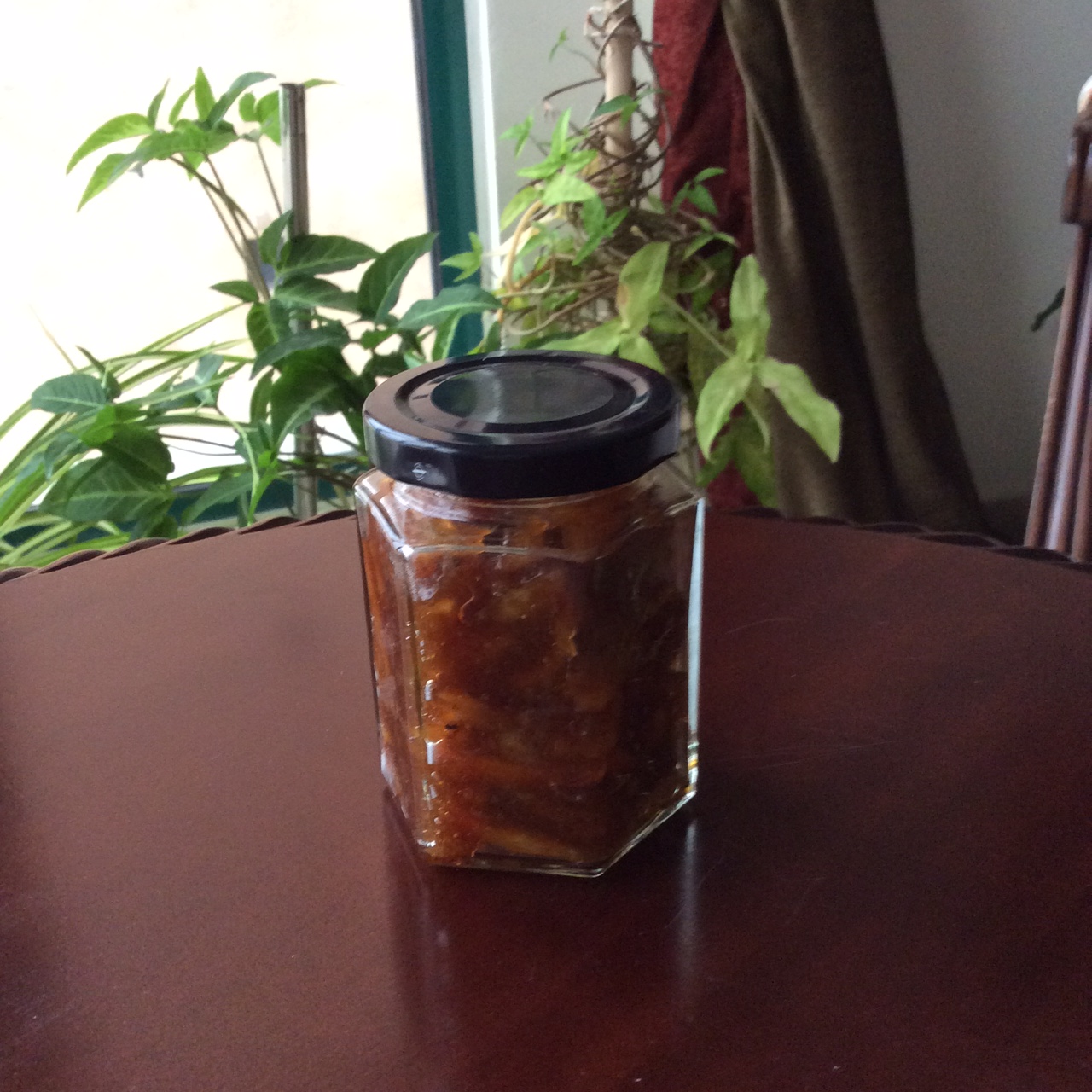
3-Citrus Marmalade

Standard

IMG_0279“Do it by the book,” she muttered as she stirred the three-citrus marmalade. Determined that today, this time, for once, she was going to follow the recipe exactly. Well, almost exactly.

She never did things by the book and was still disgruntled with that silly question she’d asked some friends, the one about the alarm clock in the opening lines. The writers’ remarks were all sensible and supportive, especially the one about “screaming in the face of the editors,” that brought a smile to her face as she stirred. Read the rest of this entry