Tag Archives: Rohini Sunderam

Visions of sugarplums

Standard

dreamstime_s_62745608Once upon a time I had a nephew, he is still my nephew, but no longer the little boy he once was, with wonder in his eyes and a lively curiosity surging through his mind. He’s all grown up now and it’s a rare thing to occasionally see that old spark of amazement at the miracle of life flash through his eyes.

Age is the Scrooge of life that takes away our sense of awe, the ability to see a world in a grain of sand and hold infinity in one’s palm. Back then my nephew believed in witches and wizards, in magic and the truth of Santa Claus.

As often happens a day came when he challenged the existence of Jolly Old Saint Nicholas and the vision of sugarplums crashed to the floor. He was rather young for that to happen so soon and I wanted so much to see his sense of wonder again.

“Of course Santa Claus is real!” I declared.

“How can he be everywhere on the same night?” he challenged me, “I know Papa or someone dresses up and pretends to be Santa.”

I was afraid those sugarplums would never dance again. So I put on my best storytelling hat and looked at him in earnest. “I’ll tell you a secret,” I whispered. “It certainly appears to be that Papa, or your grandfather or someone seems to dress up as Santa, but here’s the thing. As they slowly wear those clothes, something happens deep inside their hearts and minds. When the inside vest comes on, they’re smiling, thinking ‘Oh what fun’, but by the time the red warm flannel coat is worn and the big black belt is strapped on, the spirit of Santa Claus enters their minds and then they are no longer Papa or someone else, they become Santa Claus. Just look into Santa’s eyes tonight and tell me if there isn’t a different twinkle in his eyes.” With that I left him to think about it.

Santa arrived to the family’s raucous renditions of Silent Night and Hark the Herald. Of course he couldn’t come down the chimney in India, so with a thumping on the door and a jingling of bells he called out, “Have the children here been naughty or nice?”

I caught my nephew’s eyes; they were shining like stars of wonder. Whether he believed in Santa or not, he was excited about his Christmas gifts. The jolly old man entered and was feted. His voice was loud and booming, his belly shook like a jelly. And then it was time for the magic… presents!

I hugged my nephew, “Look in his eyes,” I reminded him. When his name was announced he rushed up and gave Santa the obligatory kiss on his cheek but he did look in his eyes. He rushed back to show his present to his parents – no it wasn’t his dad that year.

Then he came across to me. “So who was it?” I asked.

“Santa!” he said, a wonderful smile spreading across his face, his eyes sparkling, “It can’t be papa, he’s here!”

“Did his eyes twinkle?”

“They did!”

“Do you think the spirit of Santa was in him, then?”

“Yes!” he declared.

And for another year at least, Santa was real.

It is many years since that Christmas so long ago and he probably doesn’t remember this little story of mine, but the other day he posted a photograph with his baby son in his arms. And I swear I could see sugarplums dancing in his eyes again. dreamstime_xs_34782724


Of Woods & A Woodpecker

Standard

E-mail exchanges give rise to some goofing around for me. Here’s a little joke that is perhaps doing the rounds,

Two Woodpeckers

Mail Attachment10This Mexican woodpecker and a Canadian woodpecker were in Mexico arguing about which country had the toughest trees.
The Mexican woodpecker claimed Mexico had a tree that no woodpecker could peck.

The Canadian woodpecker accepted his challenge and promptly pecked a hole in the tree with no problem.

The Mexican woodpecker was amazed.

The Canadian woodpecker then challenged the Mexican woodpecker to peck a tree in Canada that was absolutely ‘impeccable’ (a term frequently used by woodpeckers).

The Mexican woodpecker expressed confidence that he could do it and accepted the challenge.

The two of them flew to Canada where the Mexican woodpecker successfully pecked
the so-called ‘impeccable’ tree almost without breaking a sweat…

Both woodpeckers were now terribly confused.

How is it that the Canadian woodpecker was able to peck the Mexican tree, and the Mexican woodpecker was able to peck the Canadian tree, yet neither was able to peck the tree in their own country?

After much woodpecker pondering, they both came to the same conclusion:
Apparently, Tiger Woods and Shane Warne were right, when they said,
“your pecker gets harder when you’re away from home”.

This resulted in the following rhyme from yours truly:

Mail Attachment9How much wood, would a woodpecker peck
When a woodpecker pecks a tree?
As much wood as Tiger Woods would
When Tiger Woods drives off from a tee!
And the ball, as happens to many a ball,
Goes whizzing into a tree.
And knocks out a piece as big as yer fist
While Woods, of course is pissed!
So is our woodpecker pecking the tree
For he’s been struck in the head like a tee
And his pecker’s been put out of joint
So he screams at the top of his voice and says
“Yer s’posed to get to the pin ya git!
Don’t you know that that’s the point?”
“I know,” says Woods who’s in a bit of a dither
“But my iron’s not as hard as my pecker.”

Loser. Baby. Mend. Wet. Only

Standard

Five words to create a story. Sometimes just one word will do. These five words were a prompt at one of the Creative Writers’ Workshops held by our Bahrain Writers’ Circle. We had to use all five words in no particular order. What story would you create given these five words and fifteen minutes?

If you’re inclined, send your story to me and I’ll publish it here.

Note: The words are in bold letters.

Only Anita knew how she felt. As far as the rest of the world was concerned, she was happy. Her smile was the biggest, brightest thing that greeted anyone no matter what, no matter when. In the rain, when it’s pouring buckets of the stuff, you’re so wet even your high spirits are damp. On days you felt that nothing could possibly bring a smile to your face, there she was: Anita, with her big, cheerful smile.

Everyone thought she was such a happy person. Why shouldn’t she be? She’d just had that lovely baby and he was all of six months old. He had a thick mop of hair that curled and flopped around his face. He was a happy baby with a gurgling laugh and he rarely cried.

All that was for the world to see.

Only Anita knew the pain and betrayal, the lies and the secrets behind the baby’s birth. In the darkest, quietest moments of the day, she knew the truth. A truth she pushed down into the deepest recesses of her mind. “How could I have done that with such a loser?” She thought. Her eyes clouded over with tears at the memory, her stomach churning with disgust. “How can I ever mend the damage I have done to my marriage? This will have to be my secret, one that I must take to my grave. Poor Jay, he must never know. It will kill him. It’s killing me. Every day I look at this beautiful child, I pray that he’ll look more like me as the years go by.”


Some day I’ll be a writer

Standard

It started a long time ago. This aching need to write. To have my name attached to a work, such and such title, by Rohini Singha. That was my maiden name. I sometimes thought I’d be mysterious and have a penname. Everyone would wonder, “Who is that writer?” Critics and reviewers would declare, “Once again the mysterious author, Madame X, has captivated her readers with a scintillating tale of intrigue.” I was a great Agatha Christie fan in the days when my dream of being a writer was still limpid in its new-born vision. I was also unclear about what genre of story telling I would pursue. Madame X was the popular appellation for a woman of intrigue.

All this gradually became something of a private joke for me. By the time I’d read more complex, character and philosophy-driven work, the desire to write mysteries gave way to some day writing the great transformational novel. The imaginary nom de plume was replaced in my mind by my own and eventually my married name. It was still something that would happen “some day”. Through the years, although it was never pursued with any intensity, the dream was also never abandoned.

I’d potter away at the writing, late at night. After various domestic and motherly chores were completed, when a particular kind of silence enveloped the house, everyone was asleep and I was still awake. That’s when the draw of pen and paper, a phrase or comment I’d heard earlier in the day, or a look in the eye of a passer-by would nag at my brain. Like a sailor drawn by a siren’s song I’d steer my thoughts in that direction, embark on a tale and let it carry me wherever it wished to go. Oh the magic of those nights when I wasn’t reading another writer’s work!

It’s not to say that I never explored the possibility of publishing. Back then it was an arduous process. No Internet. No Google. I’d submitted manuscripts to publishers and agents and never heard from them. Finally we were in the Internet era. E-publishing was a reality. I submitted yet another story without much hope but with unfailing enthusiasm to an online publisher in the USA. Several months later she emailed me, “I like your story – Desert Flower and will publish it…” I read the message three times. Tears of joy welling up and spilling over.

After all the excitement settled I looked more closely at the publisher’s site. OMG, as they say today. Romance had a broad interpretation, and, although I haven’t read it, I suspect even Fifty Shades of Grey would pale into several shades of white at the list and variety of romance on display. I couldn’t possibly have my real name attached to this! I decided on a penname for Desert Flower – Zohra Saeed. My name, Rohini is Venus, the morning star, and that’s what Zohra means. Saeed, was taken from my old guru and mentor’s first name Saeed.

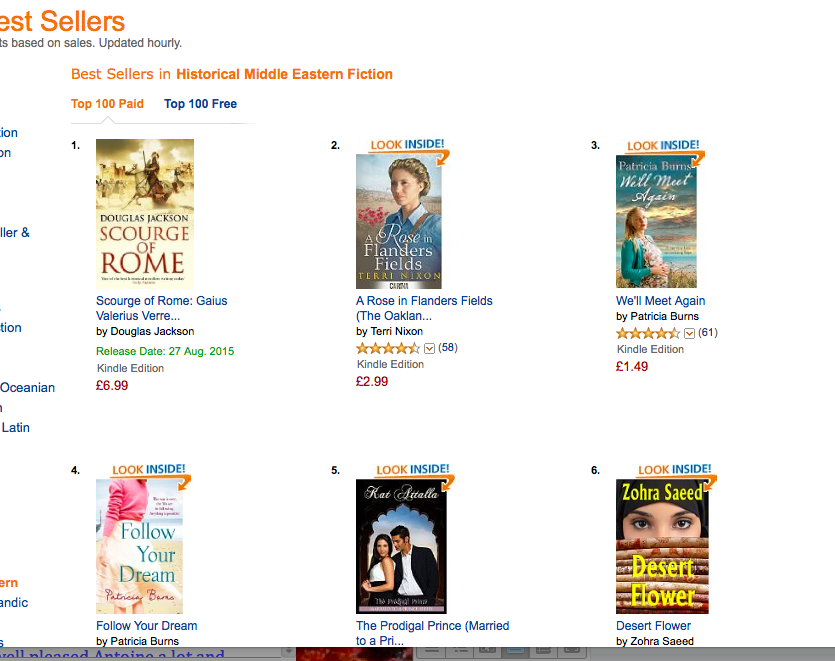
There’s a whole other story to this. That publisher eventually closed down, the rights reverted to me and Ex-L-Ence agreed to republish it. For those of you who have been following my outbursts of delight, it has done rather well over the last month or so, at one point it even reached #6 on the Kindle store. In the meantime Ex-L-Ence Publishing came into my life and published my collection of poems – Corpoetry – with my real name attached.

Two dreams have come true.
Corpoetry_cover_Page_02

Screen Shot des flower at6

Desert Flower at #6 on Amazon, UK

Corporate Dance

Standard

It happens in every office. You notice it especially when the first half of the year draws closer to its end. The little dance. The schmooze sessions. The “let’s do lunch!”

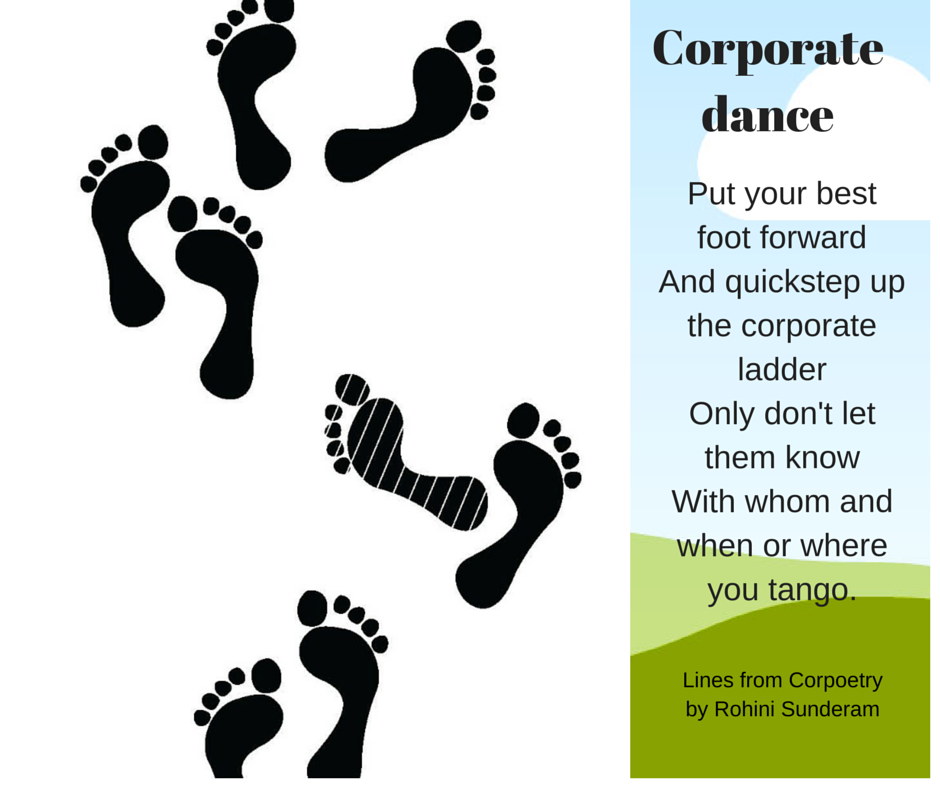
These little scenes prompted a poem called Corporate Dance in my collection Corpoetry. See how the ‘chaps’ fall in step with the boss. Watch the ladies sashay along. They’re so in sync that it’s like a choreographed performance. Not Bollywood dancing. This is more subtle. Like a tango. The challenge. The turn your face the other way, but exchange a look. It has all the verve of old-fashioned ballroom dancing and a lot of very clever footwork – both literal and metaphorical.

Putting together the collection of poems that grew into  Corpoetry was so much fun. Once the poems began to flow I couldn’t turn a corner in the offices that I worked in when I didn’t find yet another situation that prompted a poem. Sometimes reading the news – especially during that financial crisis – brought on a poem like Big Cheeses which prompted Bob Cubitt’s wonderful review. I still keep thinking that if you, as a reader, have a situation, do please send it to me and I’ll create a poem for you. Who knows, we might end up with Corpoetry Two!

corp dance

Black by Oak

Standard

Looking back through my folder and in an attempt to clear it of its clutter I came across this little gem from our philosopher poet Omar Ahmed Alkhulaqi, aka Oak/ OAK. He is now creating his own style of Instagram Verse, if there is such a thing, the appellation is mine.

The following came into existence as part of an exercise at one of the BWC’s (Bahrain Writers’ Circle) Creative Writers’ Workshops. We were all asked to express the word: Black, and this was what our poet created.

“It is the absence of all colour, the abode of secrets in the night. It is the domain and perpetuator of mystery, rooted from the ages by man’s fear of the unknown. Its ambiance resonates from its ambiguity. A frequency of doom that sets in motion the strings of terror, while the mind expands and the senses retaliate, the strings shudder and vibrate. A resonance grinding to sweep away the dusty soul and awaken the inanimate and the forgotten. An instigator of curiosity that leads to questioning, a descent of light into nothigness and the defeaning of sound into silence. It removes security and familiarity and induces a pulse of danger and vulnerability. Like a veil it blinds the eyes unbiased and unmerciful , the senses arise to fight for their survival, the terror smitten rationality struggles with irrationality. All that is grave and evil lies waiting, offering a freedom away from the light of day either to better understanding or tribulation. A menacing darkness that pervades the spirit, announcing its menace with banners of an insulting army whose motto is ‘Woe to the conquered!’.

It is a dream that finds purpose in its existence because of absence in things, taking the shape of unanswered questions and stalked by their immortal King– Death. A dream writhing to and fro, in and about and exciting the senses to the mystique. Black is of danger, freedom, courage, contemplation, vulnerability, sorrow, pain… It is bitter when denounced and sweet when marvelled. It is shadowed by darkness, and there all forsakes you, even your own shadow. For it is a colour that excites many things and is as deep as our peaceful sleep, and above all–indispensable.”

Note: You may find more of this delightful poet’s work on Facebook here:

https://www.facebook.com/omar.kuladi?fref=tl_fr_box&pnref=lhc.friends

And on Instagram follow the handle @b.t.oaktree and check out more here:

https://instagram.com/b.t.oaktree/


The Sandwich Thief

Standard

Yesterday I read a post on Facebook (someone else’s post) that I then placed on my FB page here: https://www.facebook.com/RohiniSunderamAuthor

The post is an amusing account of two colleagues and a spat they have over a turkey & rye sandwich. I mentioned that it reminded me of some of the poems in Corpoetry, like The Water Cooler. One friend said she’d like to see what I’d make of that situation in a poem.

And so, here it is!

‘Twas in an office, I heard tell

Of a prankster ne’er do well

He stole, it seems, a colleague’s lunch

And the outcome was a bunch

Of laughs for folk like me and you

But from the posts, it seems ‘twas true

And this is how it went:


“Oh sandwich thief, I know you keep

Stealing my sandwiches, why oh why?

The latest one’s turkey on rye.

Grow up you thief, you sandwich thief!”


The thief replied, “dear Turkey ’n’ Rye

I have it here, I do not lie,

Ten bucks is all that it will take

To get it back upon a plate.”


The victim lashed back with a threat:

“Return my sandwich, thief, or else!

To HR I shall take my ‘plaint

And then let’s see how you will faint!”


The Sandwich Thief, did threaten back

“Alas, my dear, alas, alack!

For every hour that you delay

Bite by bite, I’ll eat it away.”


Threats then turned to psycho chat

“Why oh why are you doing this?”

The sandwich ‘napper, not remiss

“Tick-Tock” he sent a photo back.


But in an office, as we know

Don’t push your luck for it can go

As in this case, to HR’s top

And HR weighed in with a ‘Stop!


“Cease! Desist! Return the food

And we’ll not take this any further”

But sandwich ‘napper he’s a boob

Demands a pizza, silly joker.


Next he adds an insult in

Threatens not to eat but chew

And then in little mouthfuls spew

The sandwich in a bin!


“You’re the worst” our Victim sighs

“I’m not” Our Sandwich Thief replies

And in eloquent prose outlines

The corporation’s ills and its demise.


Now, thanks to IT and what not

HR tracked down the wicked sot

“Francis!” they name and shame the chap

“Come and see us, now ASAP!”


Now Sandwich Thief, he ain’t so bold

(In fact it almost makes one sicken)

“Please don’t fire me,” he folds!

The turkey made him chicken.


The Pearl Divers’ Songs

Standard

The following is an excerpt from an essay with poems that was published in Robin Barrat’s More of My Beautiful Bahrain

As gems, pearls hold a particular fascination for me. They come in a myriad shades and colours. When they occur naturally, they are formed by an accident. A tiny grain of sand, a little pebble, enters an oyster shell and irritates the mantle. In response the mantle secretes nacre to cover the irritant and in doing so creates a pearl. What a wonderful thing to do! What a beautiful response to an irritant. Instead of destroying the unwelcome guest, the oyster lovingly encases it to create one of the world’s most prized gems.

I can’t help think, that in some ways that’s a bit like Bahrain.

At one time the area referred to as Bahrain extended as far north as Basra and down to the Omani coast in the south1 its capital being Hajar1 . I had heard of Basra pearls even before I came to the Kingdom. So the mystique and magic of the island where the pearls came from, as well as the fact that this was the place where oil was discovered in the Middle East, added to the aura around Bahrain or as they called it, more accurately in the old days: Bahrein. That being closer to the meaning, two seas.

Long before oil became the mainstay of the region, Bahrain’s main source of income was its pearls. And, if certain sources on the Internet are to be believed, the region, if not the country, was ‘historically where the world’s best pearls came from.

As I understand it, fresh water aquifers beneath the seabed in Bahrain, contribute to the unique quality of Bahraini pearls. What made and continues to make Bahraini pearls particularly precious is the fact that back then the natural pearls of Bahrain were found and collected by ‘breath-hold’ divers. In addition, the pearl-diving season was short, lasting just over four months from June until early September.

The way it was done was that the divers would pinch their noses with a short peg made from the stem of a date palm leaf. They would then be let down on a weighted rope, remain submerged for about a minute, during which time they were able to harvest an average of eight to twelve oysters. These they would put into a bag, tug the rope and they would then be drawn up by the puller – a strong hefty man, who remained on the boat. After a number of dives one lot or divers would return to the boat to rest and recover while another lot were lowered to the oyster beds. Divers were not paid wages, instead they received a share of the profits from the sale of the pearls.

Given the nature of the work, the setting sail and staying away for around four months of the year it is not surprising that a unique and traditional music was developed that was exclusive to the pearl divers. This traditional music, known as fidjeri, is an age-old repertory of vocal music sung by the pearl divers of Bahrain, Kuwait and Qatar. The Nahham, or pearl diver singers, were backed up by a chorus of singers and clappers accompanied by the mirwas – a small drum – and the jahlah – a clay pot.

At one time Kuwait had, in its sound archives, some of the best collections of recordings of these aboriginal songs and music. These were sadly destroyed in the First Gulf War during what was called the ‘Fires of Kuwait’.2

To quote Bill Badley – an expert on middle eastern music especially as it relates to the Oud – ‘This music, strange and distant as it seems, is the most vivid recollection of the lifestyle of the pearl divers, singing praises to Allah, sometimes erotic poems, sometimes hymns to the sea; and with it we are able to imagine the boats and the annual pearl diving seasons, the rudimentary but elaborate pieces of clothing used by the divers that preceded the modern diving suits by many centuries, and perhaps conjure up images of the pearl divers – their hopes and dreams and their fears of the sea as well as their life, long before the oil economy.’

Water pollution resulting from spilled oil and indiscriminate over-fishing of oysters essentially ruined the once pristine pearl producing waters of the Gulf. Today, pearl diving is practiced only as a hobby. Still, Bahrain remains one of the foremost trading centres for high quality pearls.

While researching the songs of the pearl divers I was so moved by some of the material that I felt I had to write something about them. I have tried to capture the rhythms and movement of the gentle waves of the Arabian Gulf in my poems as well as subtly echo the strong drumbeat that was at the centre of the songs. In one of them I have imagined a mythical old pearl diver grown large and titanic in size beneath the waves rising one night and to his horror discovering the cause of the decline of the pearling trade – ‘cargo ships and oil tankers’, and in another I have asked the world at large and the powers that be in the Kingdom to resurrect the beauty of both pearling and this traditional music.

And here are two poems that are adaptations of the original songs,

Pearl Divers’ morning prayer

(Adapted)

Today again I sail out to dive

To the deepest blue of the sea below

Today once again you know I’ll strive

For a pearl, a pearl that I can show.

So heave you rowers heave, I say

Today is that day, today is that day!


O morning sun, come bless our dive

Make fortune smile on us today,

Pardon our sins and bless our lives

In the name of Allah, we do pray.

So heave you rowers heave, I say

Today is that day, today is that day!


Your mercy is unlimited, Lord

And from our sins we’ve turned away,

And so we pray that you afford

A following wind and a clear, calm day.


So heave you rowers heave, I say

Today is that day, today is that day!


Pearl Divers’ evening prayer

(Adapted)

From the depth of the sea

I have risen O Lord,

Twice times ten I went down below.

The date palm peg it held my nose

The weights on the rope,

They anchored my toes.


We thank you O Creator

That you have made our lives so easy.

We thank you O Creator

For making a generous sea.


Our riches and hopes and prayers

O Lord, they come from you.

Today we bring good tidings

To our neighbours and families.


The sun, the sea and the wind

O Lord, they sting my hands and skin.

But these are like nothing, O Lord

When we see the pearls within.


Reference:

1 Manama People & Heritage by A. Karim Al Orrayed

2Reference: David Douglas’ Film ‘Fires of Kuwait’ / Bill Badley Wikipedia


Of cows, Indian cities and a story that’s yet to be told

Standard

This is a children’s story that I wrote a very long time ago. I have been trying to find a publisher, ideally in India, who’d be willing to publish it as a stand alone. It’s not very long and I’m sure that with the right illustrator it would be a delightful read for children all around the globe. It’s not a traditional folk tale but has been narrated as if it were.

Here are the opening paragraphs… Tell me what you think. What’s more, ask your children or grandchildren what they think. Would they want to know more about this story?

WHY THERE ARE COWS IN INDIAN CITIES

As anyone who has been to India may have noticed, even in large cities like Bombay or Mumbai as they now call it, New Delhi, Chennai, Kolkata in fact all over India, in cities and towns there are cows in the streets.

The cows are everywhere: on the roads, standing on pavements, nuzzling their heads in garbage heaps, lying on the side of the road, chewing cud. Sometimes they just stand and blink at the passing traffic. Sometimes they walk across the road. And, when they do that all the traffic comes to a respectful stop. And sometimes they just stand and stare at passersby with a look to remind them of something that happened a very long time ago.

Now, as every boy and girl, man and woman, has sometimes wondered, you too might ask, ‘why are there so many cows in big cities in India?’ And you might think, shouldn’t they all be in the villages and out in the fields? And shouldn’t they eat something other than scraps and straw and old paper? They should. But Indian cows are very clever and adaptable.

What’s more, many years ago they did only stay in and around the villages and never even so much as wanted to go to the cities. But, those were the days when there was only one cowherd for all the cows and buffaloes in India. His name was Govinda.

Govinda was a young man with a merry twinkle in his eye and a ready song at his lips. Sometimes he played a flute, and it was the most beautiful sound as it danced lightly like a butterfly over the cows and buffaloes as they ate grass, or sat and chewed the cud or slept. All the cows and buffaloes loved Govinda and he loved them.

The cows and buffaloes spoke to Govinda in a language quite different from ours. Whenever they needed him they would lower their heads and call out, “Gooooovinnnnndaaaa!” And he would come running as fast as he could, hopping, skipping and jumping over the backs of the cows if necessary. He could run very fast, there were some who said he could run almost as fast as the wind.

Govinda and his cows wandered wherever their fancy took them. If the cows wanted juicy green grass, Govinda would run ahead, pluck out a stalk, chew it from the roots to test if it was juicy enough and then he’d call the cows to follow him. When they moved in the direction they were called, the enormous herds looked like a great monsoon storm that was changing direction.

dreamstime_s_40282446

Desert Flower blooms!

Standard

As with so much of my writing, a chance remark, a question, a comment, often sets me off and before I know it, usually out comes a poem, sometimes a rant, sometimes a story.

And that’s how I came to write Desert Flower.

I had just started working at the Chronicle Herald, we were based in Dartmouth at the time, when I was surrounded by some colleagues all mildly intrigued by me. I guess I was something of a curiosity. The fact that I was “from away” in itself was strange. India, they had all heard of. But, Bahrain! “Where on earth was that?”

Some colleagues told me they couldn’t comprehend the heat I was talking about. And there I was, in the throes of trying to wrap my mind, my arms and my shawl (worn over my sweater, further fortified by stockings on my feet) around how cold it was and that was the middle of May.

“So, how hot does it really get?” One colleague asked me.

I started to explain it to him and then I thought. ‘I’m a writer. Why don’t I write it down for him.’ So that day over lunch, I started to write. And before I knew it, this romance story, jumped on me, like a devil on my back and every lunch hour for the next two weeks I simply had to bash out this story. Until it was done.

By then it was June. The story had gone galloping off in its own direction, so of course the colleague who’d asked the question never saw this. But I did share it with some of my other colleagues who thoroughly enjoyed it. It was too long to be a short story and too short to be a novella so it lay with me until I returned to Bahrain and shared it with some of my young Bahraini colleagues.

“You have to publish it”, they insisted.

“How do you know about so many of our old traditions? Like the ‘mashata, the dallal…”

“These are being forgotten…”

Finally, I was able to publish it. But that’s why, the opening lines are…

How can I explain that sort of heat to you?

Dry. The air so hot you can hardly breathe. The sun: a high, burning, intense fire in the heavens. You can’t look up to see it. It is shrouded in a heat haze, so that although one is aware of a single heat source, the entire dome above seems like a pulsating radiator reflecting that relentless heat back to the baking earth below.

In such a land nothing lives, save a few daring palms that would cheat the heat, and not let it extract their moisture by thickening their trunks and shredding their leaves, or scrub trees, those tenacious acacias – gnarled and thorny, husbanding their water and sap, even their chlorophyll into the tiniest imaginable leaflets – extracting from the unforgiving environment more cleverly than Shylock, life. In this inexorably cruel environment, is it any wonder that trust is a precious commodity, almost as valuable as water?

And love? It is a rare jewel. It lives as the cactus flower, bright, showy and flamboyant, but only for a brief while. It is a thumbing of the nose, from that plump succulent stem with its spiny leaves, at the heat and wasteland around it.

Such was the love that I had found so very long ago on a tiny island, just east of Saudi Arabia, called Bahr’ein, because of its two seas, the salty one that flowed around it and the sweet water sea that lay hidden both underground and beneath the seabed. So much like us, we who call ourselves Bahraini, with our salty and crusty exteriors hiding the sweet softness beneath.”

You can read the rest at any of the links provided at my publisher’s page here: http://www.ex-l-ence.com/Desert-Flower.php

As for the pen name? Ah, that’s another story.

aaa-bookshelf-119g