Tag Archives: Rohini Sunderam

…a very special Lady graces my blog today… Authoress and Poetess Supreme… Rohini Sunderam…

Standard

Thanks to Seumas Gallacher, intrepid blogger, writer, speaker, Scots…

Seumas Gallacher's avatarSeumas Gallacher

…at the risk of repeating previous blog openings, I’m the most fortunate of bloggers inasmuch as my terrific Guests come from all corners, and in all guises… since this ol’ Jurassic arrived in Bahrain, I was invited to join the excellent Bahrain Writers Circle

bahrain wrters circle

…started a few years ago by Robin Barratt, who still offers great support from his home base these days back in the UK, the group has gone from strength to strength on the broad and willing administrative shoulders of David Hollywood and Rohini Sunderam… David is an accomplished Poet in his own right, and may appear at some time on this ‘ere blog…. meantime, the effervescent Rohini offers splendid illumination to my page… let me stand aside and allow her to speak for herself and her unique CORPOETRY collection…

Corpoetry_cover_Page_02

From Corporate Laughter to Corpoetry

Rohini Sunderam

This collection of poems came into…

View original post 983 more words

More from Aman

Standard

#16968-eps_needle-thread

What do you say

To the needle that pricks you

While you sew?

There’s no one to blame,

There is only you!


T’was destiny that put you there,

And from here on

Who knows how we’ll fare.


Rocky and even

And up and down

There sits the king

For him I’m a clown.


What do you say to the

Needle that pricks you?

To some quite a lot,

And to a lot just a few.


Shush now! They say,

‘Tis just a pin prick they say

But,

That was my last drop,

If only they knew.


#2

So smile now,

And look on,

On the horror of things unfold.

These are made of your nightmares,

Look on,

As the warm wind turns cold.


So smile now,

Even though you shake and shiver.

At heart you know there’s no hope,

Nay, nary a sliver.


So smile now.

There’s no room for fear,

The beast can smell it,

Don’t let him get near.


So smile now.

‘Tis only the beginning.

The nightmares unfold,

As you feel

Yourself

Sinking.


Testing the water

Standard

Three poems by Aman

#1

Uncertainty unbound

The walls made of bricks

Hold no solace,

The hum I recall is gone!


I move to the unknown,

Yearning for the song

Which perhaps may be my own


A long wait it’s been

To hear the sound

That beckons

To the far horizon


And should the note ring true

Will I really reach that elusive hue?


#2

To yearn for a grand morrow

to have striven for the ray of thought

only to realise you’re happiest with your lot.


Know your need, not the want, ‎the path reaps the price,

Alas only the old now realise.


Even the “great” in death strive to tell us,

we depart empty handed‎ the way “He” had made us.


‘Tis just me, young in body tho’ old in mind‎,

How fortunate, I understand, there is yet time.‎

 #3

The words that you see; mean not what they say.  The path that we follow will lead us astray. A pinnacle we reach, clawing our way through a shroud, all we achieve is a modicum of doubt. Let not the rational lead you otherwise, the path turns to thorns, in our twilight we realise. Break out break through for you and your own; like Charles did eons ago unknown. We build but to no avail; our bones will turn to dust no matter o’er whom we prevail.


Corpoetry gets another 5 star review!

Standard

corp laughter_Page_21
When I first wrote Corporate Laughter, the first poem of what eventually grew into the collection I have titled Corpoetry, I had no idea that it would garner the kind of reviews that David Hollywood and now Robert Cubitt have given it!

Robert’s review is so refreshing – it’s frank and in-depth and by a complete stranger. When I sent Corpoetry to him for a review, Robert wrote back to me and said, “If I can’t give it a favourable review, I won’t review it at all.” Blunt. But I like blunt.

Phrases from his review that really thrust home for me include:
“The poems are short, use nice simple metaphors and analogies, but get to the very heart of the subject like a scalpel cutting into flesh.”

And of course, as any writer I was and I am, really delighted with:
“When I was asked to review this book the idea didn’t fill me with joy, but I love a challenge and I thought it might be challenging to have to find something positive to say about yet more poetry, but I needn’t have worried. There’s plenty of positive things to say about this collection and I’m more than happy to say them.”

The link provided above will take you directly to Robert’s review. He’s got some great “writer-worthy” material on it!

Thank you Robert!
Corpoetry is available here:
http://www.ex-l-ence.com/Corpoetry.php
Corpoetry_cover_Page_02 copy

David Hollywood of Bahrain Confidential reviews Corpoetry

Standard

David Hollywood, my friend and fellow poet from the Bahrain Writers’ Circle (BWC) has the happy post of being the resident poet for one of Bahrain’s best known lifestyle magazines, Bahrain Confidential. David, as all of us in the Second Circle Poetry Group know, is an impassioned and accomplished poet with his book Waiting Spaces available in both print and Kindle editions. And, of course he has been writing poetry for Bahrain Confidential for several years now.

You can imagine, I was overjoyed when Bahrain Confidential told me that he was going to review Corpoetry, my collection of poems published by Ex-L-Ence Publishing. I was also a little intimidated. Now that I’ve seen his review – which I hope you’ll check out – I am absolutely and utterly delighted.

David and I share approximately the same vintage, so he picked up on references that were old hat but which I’ve explained in notes to those who are of a younger persuasion. The one poem that he, and a number of others, particularly enjoy is Big Cheeses.

Which poem or poems resonate with you? Do let me know. Also, if you’re inclined, do please send in a corporate situation and I can create a poem for you. If you prefer to write your own poem, leave it here in the comments section where it can be featured.

Here’s the review!

Feb-Book-Club-470x330-470x330

With the link: http://www.bahrain-confidential.com/home/bookreview-corpoetry-by-resident-poet-david-hollywood/

Enjoy! And once again thank you David Hollywood


The Lament of Gilgamesh

Standard

This poem was written when I was in Bahrain in the 1980-90s. The Legend of Gilgamesh has fascinated me for quite a long time and continues to do so.

For those who don’t know it, here’s a quick run-down garnered from Wikipedia: The Epic of Gilgamesh is a poem from Mesopotamia and among the earliest known works of literature. Scholars believe that it originated as a series of Sumerian legends and poems about Gilgamesh king of Uruk – which is in present day Iraq.

The story revolves around a relationship between Gilgamesh and his close friend Enkidu, with whom he undertakes many dangerous quests that incur the displeasure of the gods. In one of these quests the two friends kill the Bull of Heaven and so to punish them the gods have Enkidu killed. The latter part of the epic focuses on Gilgamesh’s distressed reaction to Enkidu’s death, which takes the form of a quest for immortality. In this quest Gilgamesh tries to learn the secret of eternal life by undertaking a long and perilous journey to meet the immortal flood hero, Utnapishtim and his wife, who are among the few survivors of the Great Flood, and the only humans to have been granted immortality by the gods. Gilgamesh comes to the twin peaks of Mt Mashu at the ends of the earth through the mountains along the Road of the Sun. He follows it for twelve “double hours” in complete darkness. Managing to complete the trip before the sun catches up to him, Gilgamesh arrives in a garden paradise full of jewel-laden trees; in another legend this is the place referred to as ‘Dilmun’.

Gilgamesh notices that Utnapishtim seems no different from himself and asks him how he obtained immortality. Utnapishtim tells an ancient story of how the gods decided to send a great flood – very similar to the Flood in the Bible and Noah’s Ark. The main point seems to be that Utnapishtim was granted eternal life in unique, never to be repeated circumstances. After instructing his ferryman to wash Gilgamesh and clothe him in royal robes, Utnapishtim prepares to send him back to Uruk. As they are leaving, Utnapishtim’s wife asks her husband to offer a parting gift. That’s when Utnapishtim tells Gilgamesh of a boxthorn-like plant at the very bottom of the ocean that will make him young again. In some stories it is the pearls that are considered the “grapes of the sea” that will grant immortality. Gilgamesh obtains the plant by binding stones to his feet (very similar to how the early pearl divers of Bahrain used to descend to the sea bed) so he can walk on the bottom of the sea. He recovers the plant and plans to test it on an old man when he returns to Uruk. Unfortunately, when Gilgamesh stops to bathe, the plant is stolen by a serpent, which sheds its skin as it departs. There is a lot more and it is a far more complex epic than I have placed here.

In the Epic, Gilgamesh returns to Uruk, however, in my imagination, he never really leaves and the following poem draws on several myths around ancient Bahrain, using different names by which it was or supposedly was known – Dilmun, Tilmun, Nidukki, Kur-ni-tuk. Those interested may explore these further through that wonderful resource the Internet.

South, south he rushed

To the midst of the sea

To the place of the rising sun

To the place where some day

A king would live like a fish

Twelve double hours away.


The fifth king of Uruk was Gilgamesh

Descended five times from the time of the flood

And son of the goddess Ninsun

He sailed for a day

He sailed for a night

He sailed in search of Dilmun.


He wished to eat of the grapes of the sea

Those pearls from its bed would grant him

Eternal bliss and companionship

With the sage king Utnapishtim

In legendary Dilmun

In twice-blessed Dilmun.


Twice blessed by the god of sweet waters

Twice blessed by the god called Enki

So south he rushed south by southwest

And he met with a following wind

Until he came upon this jewelled isle

(A sad, far cry from Sumer).


Here the date palms stood tall sentinels

Their green arms stretched to the sky

Waving a warning from dusk until dawning

That this idyll would soon pass by.


But he heeded them not brave Gilgamesh

For he had reached the isle of his dreams

Then Gilgamesh dropped anchor

And entered the waters green

Where betwixt the salt through the seabed rose

The sweet waters of Bahr ein.


With stones on his feet down, down he dived

To the rocks where the pearl beds lay

He closed his eyes against the salt

He pinched his nose with a date palm peg

While he harvested those pearls of rose and grey

Harvested the grapes of eternal day

In the twice-blessed waters of a tiny bay

Off the island of Muharraq near Bahrain

Off the waters green that spread between

Muharraq and Bahrain.


How long he stayed beneath the waves

Neither he nor the sages could tell

But he took many shapes beneath the seas

Once a dugong shy then a dolphin spry

Then a shark then a dolphin again

And he sang a song a lament forlorn

Of what he saw had been done to Dilmun

And this was its burden long:


“Ah me Dilmun, Tilmun!

What became of your bearded palm trees green?

What became of your shingled shores?

What became of your soft undulating sands?

Of the burial mounds of your immortal clans?

Who has broken these temples and laid them bare

So that emptied and hollowed and ravaged they stare

At the sky and the taunting sun?

Ah me Nidukki!

Did the oil then come?

As Mesopotamia of old had foretold?

And is it true Kur-ni-tuk

That your pearls you forsook

For the sake of the black, black gold?”


And at night when a full moon is in the sky

And a Sambuk is sailing silently by

Old sailors at their fish traps say:

If you hear the shudder of an oil-tanker

Start up on a night such as this

Emanating from the sea comes a moan and a cry

And the lament of Gilgamesh.

Are Diamonds Deadly?

Standard

Recently a friend of mine reminded me that ‘diamonds are forever’, this, for those who don’t know it, is a take on the famous De Beers slogan: A diamond is forever, coined in 1947 that has since then been hijacked by others. 

Diamonds are thought to wield powerful astrological influences over the wearer. This was something I didn’t believe in, until a series of incidents – very like those in this story – happened to me. Those incidents prompted me to write this tale, now here for yu to enjoy, believe in or not…

Diamonds are forever. Diamonds are for beauty. And diamonds are for death, despair and misery.

The tiny shards of diamonds were set in silver. A little floral pattern with, at the centre, a single, soft, lustrous pearl. At certain angles the diamond dust would catch the light and then it seemed as if a thousand stars burst forth twinkling and winking in a silver night sky. At other times a ray of sunlight would be snatched unawares and shattered into a prismatic kaleidoscope; flashing and burning, the aching carbon screaming out in silence at the agony through which it was made, then hacked at to produce a diamond to adorn some trinket to delight; whilst this, this bit of dust might just have been forgotten, had not the jeweller carefully collected it and positioned it into this flower, this ring of pain; to adorn or pay homage to a pearl—yet another product of injury.

No wonder then, that this combination of hurt and insult, pain and torture should bear a sullen grudge against humankind. Together this exquisite combination of diamond dust and pearls conspired to weave a deadly web. Spinning and whirling a million microscopic electro‑magnetic atoms were set dancing around first one flower and then another in ever widening ripples, unseen and unfelt by anything animate. This impassioned dervish like dance was somehow able to set off mild imbalances which could sometimes go off at a manic tangent…

The web was spinning. The trap was set.

The diamonds shone, in spite of being mere dust their combined sparkling could easily have been the envy of anything near a carat. Meanwhile, the luminescence of the pearls was like a softly beckoning beacon. The lady looked at them, passed them over and looked at them again…all of a sudden they seemed to be the most beautiful things she had ever seen. Was the angle right? Was a skein of light ever caught so daintily? Or, did a sudden alteration of electricity in the air set the ‘web’ spinning extra specially just for her? No one would ever know. But, one step in a certain direction leads fatefully to another and another.

Other pearls were seen. Garnets passed through her hands as though in a daze. Bright green emeralds, corals, more pearls, opals, rubies… opals, rubies… but her eyes and her hands kept straying back to that dainty set of pearls and diamond dust, diamond dust and…

”I’ll take it,” she said, “This and only this!”.

Clutching the set close to her, her heart beating just a little bit more rapidly, her eyes shining; she hurried home feeling slightly guilty as if she had done something wrong. But what it was, she wasn’t sure.

The malevolence of that beautiful combination went into action

the very next day. The lady woke up with a sense of unease, as if she had been involved in an illegal assignation. Alongwith it a mild headache. “Oh, It’s nothing!,” she thought, “Why should I feel so wretchedly guilty about it?”. And the diamonds were put impatiently out of her mind. Other more pressing problems were at hand and needed to be dealt with immediately. As the day wore on, and the evening drew near her spirits rose.

Her cheeks were flushed and her eyes took on a heightened lustre. That evening she would wear the set. What should she wear to go with it?

She dressed, all a‑glow The pearly pink of her dress imparted a blush to her entire body and she exuded a kind of youth and ebullience she had not felt in a long, long while. The world was wonderful and somehow she was at its centre. And, holding her there on its silvery, sparkling, adamantine threads was her floral set of diamond dust and pearls—on her ears, on her hand and at her throat.

Later that evening, just at the moment when she felt that she had attained a pinnacle of emotion between herself and a kind of void that could only be thought of as the whole world, something snapped!

A minor quarrel with her husband. It marred the feeling of giddy perfection, as if a pin had scratched a mirror. Strangely. Indelibly. A sudden shrinking within herself was all that she could feel, or put her finger on.

Days came and went in a blur. Nothing seemed wrong, but nothing seemed quite right either. Deep within her heart a pin‑point of pain was minutely growing.

Her son fell ill. Something he hadn’t done for years. Feverishly she battled to bring the high night-time temperatures down. Every night for six nights she fought the fever with cold compresses and medicines. Pre‑dawn on the seventh day, from nowhere came the thought, ”Are diamonds unlucky?” Then, she said to herself, ”Nonsense, this kind of thinking is superstitious rubbish.” Her son recovered. He looked pale, but he did seem better.

Her daughter followed. A fever, a cold, a strange listlessness.

And the thought crept into her mind again: “Are diamonds deadly?” And again she brushed it off. Impatient with herself. But, now the thought bounced around in her mind like a fly. Like a fly caught in a web.

Mid‑sentence she stopped someone, mid‑sentence, discussing the weather, she shot it out, “Are diamonds unlucky?” Mid‑sentence, mid‑stream, mid‑thought.

“Yes,” came the astonishingly confident reply. “Yes”, it rang out like a death knoll clanging like a horrible bell through the hollow caverns of her being, ringing death and destruction, “YES”, then almost softly, ”I have heard something, do you remember the Hope diamond?”

Hope? There was no hope, never mind that hope was only a family name. There was no hope at all. It surely had to go. No. That was rubbish. Superstitious, foolish, middle‑ages‑type nonsense.

And yet the thought persisted, making her head ache.

‘Are diamonds unlucky?

Remember the Hope diamond?

But this is only dust.

But it is diamond dust.

Some diamonds are forever.

Is bad luck forever?

No.

Yes.

Diamonds are for death.

Diamonds are for despair.

Nonsense…Yes!

Rubbish…No!

The diamonds must go!

But they didn’t. They lay there. Silently maliciously spinning, weaving their intricate pattern of destruction. Rippling out quietly, persistently, continuously. Setting her world just slightly askew. No matter what she did or whatever happened, if it was undesirable, the diamonds would flash winking horrid and gleaming in her mind’s eye. And she would shake her head as if to rid her mind of an ever‑growing tangle that seemed slowly inexorably to mar her vision of the world.

A few weeks later her mother came to stay. Her heart grew tight as if with a sense of foreboding. Not more than two days had elapsed when it came down upon her heart with a thud. Her mother developed a sudden fever. Hack it went at her, ‘hack’ at her heart, “Get rid of the diamonds.”

Her mother’s fever rose in spite of all the medication. Bathe her brow. Give her water. Do something…Get rid of the diamonds.

It went at her like a hammer, sparkling in some stygian light, ringing out in the night, through her sleep, through her vigil, through the dark, through the light.

Finally she could take it no longer. She grabbed the tiny black box, ran with it back to the jeweller, and burst out…”Get rid of…get rid of it…” The tears streamed down her face. Her body trembled as if from a terrible effort.

The deed was done. And after a while a kind of calm settled upon her. That day the cause of her mother’s fever was diagnosed and treated correctly. But, not before the old lady was made to witness the spectacle of the shadow of Death’s face before she was flung palpitating, back into life. She was drained temporarily of all her strength, while her daughter watched helplessly aware of only one thing…a last malevolent flicker of diamond dust, still winking enticingly at her, before an empty darkness   settled into a corner of her mind.

Intimations of old age

Standard

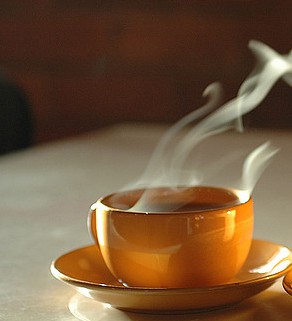
Natural-Ways-To-Cure-Headache-Hot-Cup-of-TeaWhile going through some old papers, like many a writer, I find fragments of things I’ve written over the years, mostly poems, sometimes stories, and sometimes rants. This one is in a melancholy mood, reminding me of my first nostalgic recognition that time was catching up with me and could soon run out.


“Grow old along with me,”  you said

Sipping tea, aromatic with bergamot

Steam rising like a ghost,

I smiled,

Ready to join you on that journey


We ran across

Piano keys playing seconds

Racing up and down the scale

The assonances picked up

Wedding rings and kisses

Children

Sharps and flats.


The melody of spring time

Chased by summer’s desertification

Of our lives

That

And the first grey hair in my mirror.


Forgotten by the time autumn

Had ripened our fruit

Sent dandelion children

Floating on the breeze


Again I fill your cup of tea

Just one now, no sugar

Still bergamot flavoured

With steam

Escaping like warm breath

At the start of winter’s chill.

Hanging by a Thread

Standard

The past has no power over the present moment.There were days when Lily came close to opening that doorway in her mind behind which lay the safety of insanity. Its still, padded walls of quiet called to her. The peace of catatonic nothing that lay beyond were like an oasis seen from a distance. And the temptation to walk into that haven of light was sometimes strong enough to taste, like tea boiled with cardamom and cloves, the way the natives made it. The door was held shut by a single emotion, a tiny fragile thread: love, and it brought her back through tears, frustration, anger and despair to face the reality of life. Love, so ephemeral and intangible so seemingly frail yet strong enough to ‘launch a thousand ships and set on fire the towers of Ilium…’ Love so great that God had sent his only begotten son so that we would not perish or the kind that could lead one man to lay down his life for another; but for a woman, a mother like Lily, even more, that love demanded that she should continue to live and continue to be sane.

She took a deep breath, weighted with the sorrow of her losses, let the tears take over and hugged the baby. “I will never leave you,” she murmured into his ear, “Never. Ever.” She held him and swayed back and forth in the motion of the tides governed by the moon, that unstable celestial body that ruled the hysterias and moods of women, yet when emulated by them had such a soothing effect.

The rocking motion calmed the baby’s cries and her own frantic heart. Now, she could get through the next few hours and the next, from one day to the other. For two months she’d managed to put away the cruel reality that had snatched her daughter’s life and left her, Lily, quite literally holding the baby, her baby’s baby. A wry laugh escaped her twisted lips at the pun, “Or else you’ll have no one and I’ll never let that happen. We’ll manage. We have to manage.” She kissed his smooth creamy face, soft as innocence, as she pushed her own unruly chestnut hair back into the loose bun at the nape of her neck.

“Why don’t you give it up for adoption?” Her crusty father, up as usual at this hour of the morning, his cigar clenched in his teeth, his clean-shaven face and immaculate shorts and shirt asserting his ‘burra sahib’ status as the owner and manager of this tea estate.

“Father! He’s not an ‘it’ he’s Mary’s son, her baby,” and the tears pricked afresh at the back of her eyes, indignation saving her, “for God’s sake!” She gently laid the baby down in his crib. “We haven’t even thought of a name for him,” she half whispered.

“A name!” he growled, a low rumble thundered in his throat and exploded into, “For God’s sake, Lily, he’s a half-breed! And will be no use to anyone. Get rid of it I say!” His blue eyes were steel in their rage as he moved towards Lily his hand raised.

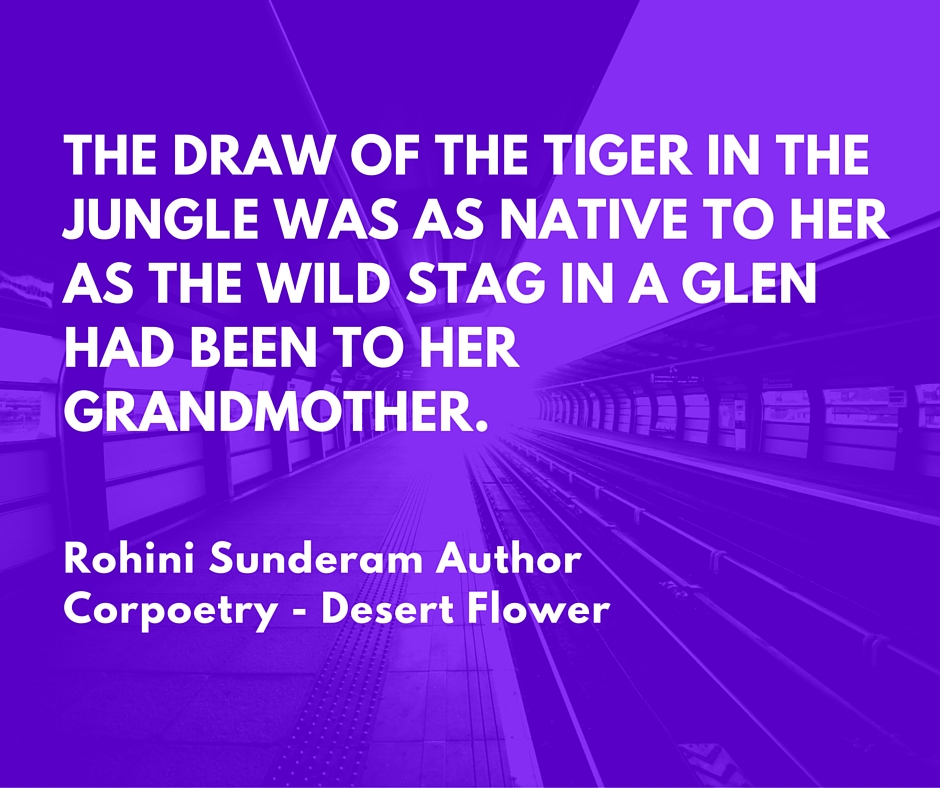
“Da! Mary was raped. How can you say such a thing?” Lily lost control and wept openly but stood shielding the crib behind her. She was a Bengal tigress in her roaring challenge. For all her pure Scottish ancestry, Lily’s upbringing in the tea gardens of West Bengal had given her a strong affinity with her habitat. She responded with greater warmth and joy to wild orchids and tropical ferns than she did to heather and gloaming. The draw of the tiger in the jungle was as native to her as the wild stag in a glen had been to her grandmother. Whatever feral creature’s influence led her to stand her ground over her tiny grandchild shone with the power of pure primeval nature and her father stopped.The draw of the tiger in the jungle was as native to her as the wild stag in a glen had been to her grandmother.
He wheeled around on his heel and walked out, grabbing his sola topi and rifle. The ‘Da’, his daughter’s affectionate word for him and her flashing green-brown eyes, like her mother’s, had stopped him from striking her. It was all he could think to do. Thick as bile in his throat the rage almost engulfed his brain. But there was a tea plantation to run. He pushed the rising bile down marched out, mounted his motorbike, and expressed his frustration by loudly revving the accelerator making his bike roar. It startled the birds and creatures of the Kipling-like jungle beyond, rich with its leeches and leopards, its regal tigers, opulent orchids, brooding monsoon-green ferns with their grasping fronds and wild pineapples. At this stage in the history of Man it was an indomitable force of nature, unaware and unmindful of the future in which its luxurious abundance would one day be threatened by such as that man, his motorcycle, and its black smoke: flatus that carried with it the stench of tomorrow.

‘Da’ there was no one left who called him that, or Fred in the affectionate way Lily’s mother Mary Rose had once done. It was mostly sir, sahib or Mr. MacDonald. Those who had once called him Mac lay six feet under at the Siliguri churchyard.

There were enough problems trying to run the estate without having his daughter leave him as well. As one of the few remaining British tea garden owner-managers left in Assam and West Bengal things were becoming increasingly hard to hold on to. Almost the entire family had gone ever since India gained its independence in 1947. After his wife succumbed to her third attack of malaria, both his sons decided they’d had enough and returned to Blighty. Eleanor, his other daughter had gone to the UK, studied at Cambridge and married a scientist. So she wasn’t coming home.

‘Home’ he thought wryly, ‘where is it?’ Not Scotland any more. After thirty years in India, he could never feel at home there, not even in Glencairn the family estate with its sprawling lands, streams, ponds and mists that brought ol’ acquaintance to mind. ‘For a’ that an’ a’ that it still wasn’t home for him. Home was east India, the tea gardens and the jungle; the sweat of hard work and the buzz of playing hard: tennis, squash, or a punishing six-a-side soccer match with another garden and beer or a Gin ‘n’ T to follow. ‘Aaah, those were good days’, Fred MacDonald thought to himself, the very act of recalling them calmed his mind as his wife’s cool hand once had.

Fred MacDonald’s old acquaintances were, like him, Scotsmen to whom India was home. The khaki shorts had replaced the kilt and sahib had replaced the word laird. He could no longer stand the damp cold that seeped into his bones in Scotland like mould in tea and like mould it could create much damage. It needed to be stamped out with dry heat, the kind he generated in the drying chambers on the garden deep in the jungles of Bengal, it was the kind of heat that kept his arthritis at bay.

Lily and her husband Tom – another tea planter – had stayed on in India, relatively close to the MacDonald estates. While that had lasted they had been family and home; joy and fun enough for him. They had laughter and parties where the rafters rang, as they would have at any clan gathering in the highlands. The whisky had flowed along with the English concoction gin and tonic to keep the dreaded malaria at bay. In spite of that, his Mary Rose was lost to the rigors of the disease as insidious as the slow uprising of the Indian Freedom movement and eventually as devastating to the body politic of the once great British Empire.

Then Tom died in that horrible accident when a rogue elephant overturned their jeep. And the world lost its orbit.

Lily moved back with him and appointed an Indian manager on her estate – there were getting to be quite a few of these Indian lads now, not a bad lot, many with an English public school upbringing so they were easy enough to get to know, but it wasn’t what it used to be. But what were his choices? Sell out to one of the companies, head back to Scotland and let the moss erode his soul? Never! It was better to have romantic memories of Bonnie Scotland and live the real life grandeur of a tea planter in India.

His was the lot of all displaced people since time immemorial, one foot in the past across the sea and another in the present on different soil with neither foot sure where to plant itself so that the émigré was forever shifting his backside, attempting to get comfortable in one place or the other, never truly at rest in either one. Rest was only for the next generation; sometimes they paid lip service to their ancestry, but most times they moved ahead without a backward glance, like Lily who was, as far as he could tell, more Indian than Scots.

Fred steered his purring motorbike forward, automatically guiding it through the paths between the tea bushes. The workers, all women, were busy picking their two leaves and a bud from the tea bushes and popping them into the baskets on their backs. They acknowledged him with duly servile greetings; their smooth berry-brown faces gleaming in the morning light and turned back to their daily job intent on picking as much as they could to get a better wage at the end of the day when their basket-loads were weighed and tallied.

The sun was just cresting the top edge of the jungle and the late mosquitoes buzzed as they slipped into darker crevices in the undergrowth. The occasional croak of a frog suggested an impending shower and a thin wisp of smoke from a nearby fire snaked wraith-like through the jungle. It sent a shiver down Fred’s back as his thoughts returned to Lily and inevitably to little Mary, or Mary-baba, as the servants called her. She’d been the darling of his eye and life, poor baby, raped at thirteen. “Why, for Jesus’ sake hadn’t they had an abortion?” The anger bubbled up seething swamp mud in his brain. Then he remembered.

It was months before they’d realised the rape had resulted in pregnancy and it was too late and too dangerous. No one in this God-forsaken village was competent enough to do it. They’d have had to go to Siliguri or Calcutta. And there, no decent doctor would have agreed to do it as it was illegal, and with the others, “who knows, we might have lost little Mary sooner.” The thought sobered and calmed him but did nothing to lighten his mood, dark as the gathering pre-monsoon clouds.

Back at the bungalow, Lily had calmed the baby and he was fast asleep in his little crib, the mosquito netting firmly tucked into the mattress, his tiny, perfect milk-tea coloured thumb just nudging his still moving lips. The infant innocence that declared all humanity’s first God-given purity, before the fruit of the Tree had condemned Adam’s descendents to knowledge and to hell. This poor innocent child was condemned to be called bastard through no fault of his own. Lily looked at him and the thoughts swirled around in her head, a miasma of fear and hate, anger and despair. What should she do? Take the baby back to Scotland? The thought plunged her into the dark space from which there was no escape, save through that doorway in her mind. But she knew if she walked through it, she would abandon her little grandson. She gritted her teeth and held on.

A tiny whimper from the baby brought her back into the present. She rose from her chair and peered at the child. It was just a dream. She smiled, went to the door and softly called out, “Koi Hai, is anyone there?”

“Memsahib?” the servants always appeared out of nowhere.

“Chay, teapot mein, make it hot-hot,”

“Yes, memsahib,” and Muna, her old ayah’s daughter, the next generation to serve the MacDonalds, went scurrying off to the kitchens. Muna had a sense of special importance in the big house or ‘burra’ bungalow as the natives called it. Deep down she even had a sense of ownership towards it. As a second-generation domestic and personal maid she was highly respected by the rest of the staff. At nineteen, she had achieved this special status quite easily. Her mother had been Lily-madam’s personal ayah from the time Lily had been a little girl. When Lily married Tom, Muna’s mother had worked for her and Muna had helped around Lily’s house, even as a little girl. Eventually, Muna became Mary-baba’s playmate and then her ayah until the dreadful incident that eventually claimed the young thirteen-year-old girl’s life.

Muna had a special bond with Mary-baba that went beyond the love of a nanny for her charge. The day Mary was attacked Muna had taken her day off. It was never clear whether the man was a tea garden worker or a stray from a passing nomadic tribe. Mary couldn’t say and shuddered horribly when asked; her only response had been a high-pitched keening.

Muna blamed herself and prayed fervently for forgiveness in church, as a Naga she was a baptised Christian, and as a Naga she knew that if she’d been around that day, the rapist would be dead. Muna carried a sharp knife under the waistband of her skirt and knew enough martial arts to decapitate a man and a snake. She could also throw her knife with enough accuracy to kill a pheasant. Neither Lily nor Fred knew of the young girl’s abilities other than as a domestic servant. They may not have slept as easily had they known; distrust of the servants was second nature to the rulers. One was always careful around them. And yet this distrust of their honesty was countered by an abiding faith in their loyalty, although Fred had always displayed a special affection for Muna.

She entered the large kitchen house – a detached building connected to the main house by a thatched passage – and imperiously ordered one of the junior cooks to make a pot of spiced tea, the way Lily memsahib liked it. “Tray mein!” she ordered, as the young man carefully placed milk and sugar in their tiny bowls and two biscuits in a small saucer on the tray. With the tea cosy firmly on the teapot she hurried back to the bedroom veranda where Lily had moved the baby’s crib while she sat on a cane chair dozing lightly in the cool morning breeze.

The house was still in that expectant way the world gets when it awaits the first rains. The light outside had a metallic glint and the birds had ceased their chatter. The only sounds were Muna’s bangles and anklets as she hurried to give Lily her tea. Her senses were at a sharpened alert and she quickened her pace through the darkened corridors to the deep veranda near Lily’s bedroom.

She cocked her head as she heard Mac sahib’s motorbike, its engine cut, as he coasted it and crunched over the gravel towards the side of the house where he knew Lily and the baby would be at this time of the morning. He reached Lily’s bedroom veranda at about the same time as Muna slipped through the swinging net doors of the bedroom and set the tray on the table.

Then both maid and master stopped, gasps of fear choked back in their throats, every hair on their bodies alert.

Lily sat dozing on her cane chair, unaware of the danger that the jungle had disgorged in its earliest retaliation to human encroachment.

Crouching and ready to pounce, was a panther, driven out of the jungle by hunger and a lame foot. He turned as Fred’s bike crunched over the gravel. Then, intent on his prey, the baby in the crib, he leapt.

A flashing silver dagger sliced through the air as Muna flung it with all her might. It caught the panther in its throat but didn’t stop it. Simultaneously Mac’s rifle flew into action and caught the animal in its shoulder as it crashed onto the crib still alive, yawling its anger and hurt, waking the screaming baby who was unhurt.

Lily leapt to the crib pulling it away from the animal’s thrashing paws as the mosquito netting slipped off and entangled its head and forelimbs while she caught the infant in a protective embrace.

In one giant stride Mac jumped onto the veranda and put a final bullet into its head. One part of him aching as he saw that proud head shatter and the blood spatter across the spotted body like so many of his dreams, its dreams and the dreams of his once great country.

He dropped his gun and hugged them all Lily, the baby and Muna, kissing each one fiercely. “My children! My dear, dear children!”

“Da,” Lily asked hoarsely, “all of us?”

“Yes!” He replied gruffly pulling out his handkerchief and blowing his nose, “the baby too!”

Muna went to retrieve her knife, have the panther removed and the mess cleaned up. As she walked away, for the first time Lily noticed that Muna’s dark hair had a hint of red, she wondered if her eyes also had a hint of blue.

“No matter,” she thought, “if we’re a family, then we can hang on.”

A challenge

Standard

I received this challenge, ‘create a poem on the following picture’

Unknown

my response:

When Hope was captured in a jar

Pandora set her free

But not before she had unleashed

Every evil that could be.


Some would set a caged bird free

To fly unfettered in the air

And some would say that keeping it

Safe, shows that you care.


But Hope and birds and butterflies

And bats and spirits too

Artist’s hearts and writers’ dreams

Must soar and never rue


The strictures and the structures

Of form and shape and size

They must explore the wider world

Of fiction…

And the poetry of lies.