Tag Archives: writing

Birthing

Standard

Rohini Sunderam

ID 221617137 © Partha KarDreamstime.com

The so-called winter in Calcutta pushed the mercury to 25C. One moment the wind was warm, heavy with humidity blasting up from the Bay of Bengal carrying with it a reminder that this had all once been a swampy rainforest. The next moment it sent us a chill message from the faraway Himalayas, it’s still winter.

My belly was large, bulbous, weighed down by the baby. I’d taken to wrapping a shawl around my waist to help support my stomach.  The kicks and rolls, the tiny fist jabbing inside me had gone from a tickle that made me giggle to a physical pain. “Your previous caesarean scars are stretching as it’s growing,” the doctor had explained. 1980 was a time when an ultrasound just confirmed that the baby was okay. We neither knew nor cared about gender. 

The ‘IT’ was the baby. The doctor’s face was implacable. Bedside manners hadn’t become fashionable yet. “Rest”, he advised me. His expression was stern the lines drawn down from his spectacles to his jowls were twin wrinkles, pushed deeper by bulbous cheeks. ‘Too much macher-jhol* and rice’ I thought. Back then patients didn’t make cheeky comments to their doctors. 

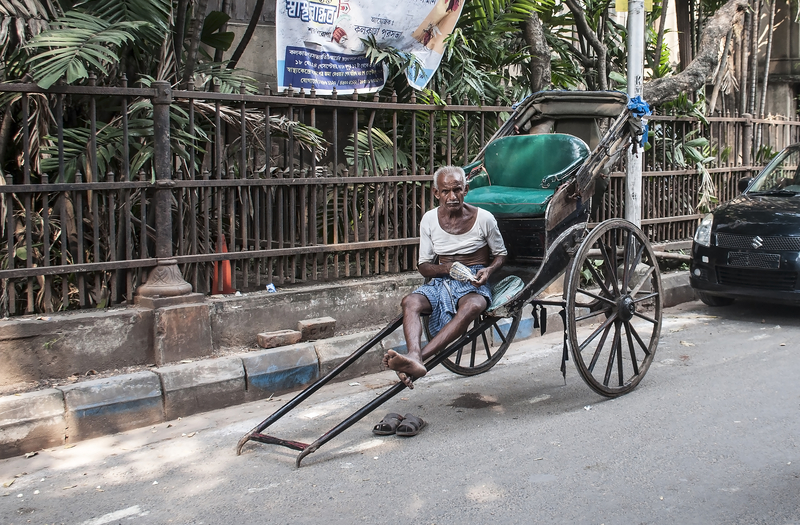
When I limped out onto the street, I was close to tears because getting a cycle rickshaw to take me home at mid-day would be impossible. It was too far to walk and too close for a taxi to bother. I looked around and saw an old hand pulled rickshaw runner. He jangled his single large bell, that looked like the tiny ghungroo bells worn by classical dancers on their ankles. I hadn’t taken a hand pulled rickshaw until then, it seemed so demeaning to them. Reminders of the British Raj, still so omnipresent in Calcutta, were interrupted by a sharp twinge of pain. I grimaced. 

He smiled, waving a fly from his grizzled face. “Daughter, where do you want to go?”

“BBD Bagh,” I said, “How much?” 

He quoted a price. I readily agreed and clambered onto the rickshaw, landing with a thump on the seat as I thanked him profusely.

“I thank you,” he countered, “Not many people take our rickshaws these days, it’s my only livelihood. And many of us must give up the job.” He panted. His slow pace had picked up to a steady jog, “we barely make enough for our daily food.”

I watched his thin sinewy legs as they pumped up and down. His feet were bare and thickly calloused from years of hitting a hot tarmac. 

Guilt, like a monsoon shower, washed over me when he stopped in front of my building. I wanted to make it up to him. “Where do you get your rickshaw bell?” 

He laughed. “Why?” 

“I want it as a souvenir,” I said. 

“You can take this one,” he offered. 

“How will you call your fares?” Tears of remorse pricked my eyes. “What had I done?”

“I have an extra one,” he said, pulling up the seat where I’d been sitting. Under the worn red leather cushion, he had stored his meagre belongings, an almost threadbare grey blanket, rubber slippers, an extra loincloth, and striped underwear. He pulled out the grey, aluminium bell with a leather thong strung through the hoop at the top.

“How much?” I asked. A cool breeze washed past me, a benediction, for my good deed? It cooled the perspiration around my neck.

He laughed, a few teeth were missing, the rest stained red-black with betel juice. His dark sun beaten face and grey beard were almost demonic, but his jet eyes were gentle and the crow’s feet crinkling in amusement made me smile. 

“Whatever is easy for you madam. I bought it a long time ago.”

I handed him thirty rupees, “for the fare and the bell.”

“Madam, it’s too much.” His jet eyes glistened with emotion.

“From the baby and me,” I whispered, “Give me a blessing.”

“Of course, of course”, he said coughing up phlegm which he spat into the street. That was Calcutta. “Live long, daughter, bless you and the baby.”

‘May it be normal,’ I say in my mind. It’s the closest I’ve come to praying in nearly twenty years.

I put the bell into my handbag which I slung over my shoulder. Then, holding my belly under my shawl, I climbed the steps to the door, pushed past it into the cool dark foyer. I pressed the button for the old black wrought-iron lift that clanked on its way down.

I felt lightheaded when I got home and lay down as the various helpers got me water, tea, and turned on the fan. 

When I awoke, I was being rushed on a stretcher past green curtains. My doctor and an elderly lady anaesthesiologist were rushing beside me. I wanted to ask, “what happened?” but my tongue was stuck to my palate, and I couldn’t get any words out. I knew where I was. Had I fainted? Where was my husband? I was in pain; his hand was on my arm. “It’s all ok”. His voice was husky. 

I slept again. Jagged neon lights slashed my abdomen. Pethidine. Is my baby ok?  In the early morning dark, tears burnt my eyes. Until the previous afternoon when I bought the rickshaw puller’s bell, I had abandoned God and prayer. 

I tried to say, “Our Father…” but it stuck in my throat. I demanded of Him, “Give me my baby whole and complete, and I’ll return.” It was a promise. A challenge. Not a prayer.

 “Your baby,” the nurse said, and I took the little girl in my arms. She had a shock of thick black soft hair. I put her to my breast, she sucked hard at my nipple. Her will to live hurt. I examined her fingers, toes, face. She was perfect. 

I reached in my handbag for a tissue and felt the rickshaw puller’s bell, “Your birthday blessing,” I whispered. 

A pink dawn cracked the sky. I looked heavenward, “Thank you.”

(*Macher Jhol – Fish curry)

1ID 197103301 © Michel ArnaultDreamstime.com

Will it won’t it?

Standard

I don’t recall whether I entered Twelve Roses for Love for the cover of the month contest at All Author, or whether it was randomly selected. But one evening, in the midst of a Skype conversation with our daughter and while simultaneously checking email (yeah, I do that sometimes), I saw this email from All Author informing me that my book cover was up for the Cover of the Month contest for April.

“Oh, dear me,” I declared in a rather C-3PO-ish voice to myself, “I better do something about promoting this.”

First I sent out emails. Next I posted it on Facebook and Twitter. Then I sent it to family and friends’ WhatsApp groups. The votes started to come in.

When I first looked at the rank it was at #24. Hmmm not bad, I thought. Then obviously the votes started to come in. Now the excitement began.

Friends and even some folk I don’t know voted for the cover. It rose rapidly through the ranks. Then it got stalled at #9. But after a while there was another spurt and it shot up to #3.

My heart was beating and I got quite caught up in the thrill of the chase. The next time I looked it had gone to #2!!!

Wow wooooow! I thought. OMG as they say these days. I started thanking everyone. By then the better part of the day had been spent in checking the status and trying to bake my annual batch of hot cross buns 🙂 I was emotionally and physically still on a high, although my legs, by now were aching.

Last thing at night I looked again and it had dropped to #4!

Oh dear, I thought, this is nonsense. But I can’t stop myself! I looked again just now so it’s hopped up to #3 again

And the latest, as I go to “press”, is that it has fallen to #5.

Dear readers, can we boost this up further? If so please visit and vote…

https://allauthor.com/cover-of-the-month/11356/

A Prose Poem

Standard

Bereft

Your leaving would take the middle out of my life. To say that I would miss you is like beggars’ alms, for they are a beggar’s words. I would be desperately alone and the world would not know it. I would laugh as I always have: too heartily. But, I would not cry. To think of life without you would be like drinking tea from a saucer, too hot and then too cold. It would be like climbing Mount Everest and not finding ice and snow there, yet having lost a limb to frostbite. To think of every day, crystallising without you is emptiness so vast I cannot comprehend it, like light not comprehending darkness. The very aliveness of the world, the very death in me, a zombie; gyrating from one true pure function to another; that would be me without you. 

The loneliness of the heart you have already known, but picture the strangeness of my soul without you.

Park Bench Stories

Standard

It’s been a while since I had a story to post. This one’s a sequel. Something I haven’t done before. It was sparked by a Facebook post that popped up thanks to their algorithms that remind you of a post three or five or more years ago. This one was called The Park Bench, based on a prompt given by Shauna Nearing Løj. This story has been particularly popular and has twice been released in Spain, courtesy Gerry Wright.

Fast forward to two days ago when a friend from the Bahrain Writers’ Circle, Veronica Selvarajan, read the story and made the comment, “I am going to be wondering if she ever reciprocates….” Well, of course that possibility wouldn’t leave me alone untilI had written the sequel and decided if she’s ever going to reciprocate. Well, Veronica, Cynthia, Charlotte, Joy, Malini, Gerry, Ajoy, Pam, Aruna… and many others. I’ve become a romantic in my old age.

The Guy at the Park

by Rohini Sunderam

She’d never really forgotten him. The young man at the park bench who always asked her if she’d ‘found a young man’. There had been a marked electricity between them. It was palpable through book after book that she read almost every workday afternoon. All he ever did was chew a fresh blade of grass and look up at the sky. There was a quiet confidence in his cocky voice and silence. He lived in the moment. Enjoyed the breeze, the birds in the sky, the clouds, the trees. Over the years they had developed a silent, comfortable, companionship. It was a quiet hour every workday that she kept for herself, before she took the bus home. They had hardly ever even had a conversation. He had grown strong and grown up since that spring so many years ago when they first shared the park bench. She had never learnt his name, nor what he did for a living.

And yet, all these years later, she remembered the look on his face the day she told him she had ‘found a young man’. He wished her well. But his eyes went dull grey like an autumn sky suddenly robbed of the sun.  And something in his face crumpled. But he didn’t say anything to her when she broke it to him. She wondered, ‘was all that electricity just in my head?’ She’d risen from the bench and had disappeared from his life for twenty years in the big city.

Twenty years, she said to herself. Why did I put up with ‘my young man’ for that long! There’d been that early euphoria of being married, being in the financial centre of the country, of looking after a house. But she and Bill had never really had much in common. He constantly wanted to go to this party and that restaurant, spend a fun time with his friends, anything but come home to an evening of quietude, an hour of  reading or listening to music.

He’d come back from work and it was, ‘Right, where are we going tonight?’

Her responses, ‘but I’ve just cooked this lovely dinner, I thought we could enjoy it together,’ were usually overruled.

Occasionally he’d agree and then it was a sullen silence they shared, nothing calm and companionable like it was with the guy in the park. That was a magical hour; the park was a Tom Thomson painting, the colours fixed and immutable. Instead, the meal she had so carefully prepared was wolfed down without a word of thanks and then he’d want to go out for a nightcap. Being a lawyer meant he could afford all that as well as the house. After a few years he went out on his own. Leaving her to her still pool of solitude that bordered on loneliness and her books that transported her on their magic carpet pages to other possibilities.

The miscarriages hadn’t helped either. Her mother had assured her things would improve once a baby or two arrived. After the first two losses, when she felt her world had been wrenched from inside her, her soul and heart shattered into a myriad shards of glass that cut her every time she saw a couple with a baby in a pram, Bill had grown more distant. The doctors said she wasn’t likely to have any more. Bill’s night-time forays became more frequent. Then there was his affair. Secret and sly, sordid and so typically with his secretary. Sinning is hard only the first time, so it wasn’t long before there was another affair and another.  Finally, the divorce and when her mother died, she decided to move back to the small city. The house was hers and she could easily get a job, perhaps even her old job at the library.

It was a cloudy day in November when she thought of going to the park with her book. ‘For old times’ sake’ she said to herself, he’s probably not even there any more. The years had flown like the clouds overhead. She was as nervous as a teenager as she walked in her high boots and her camel trench coat down the path towards where she remembered the bench used to be. It was four o’clock, her usual time from force of habit.

There was a man on the bench. Sitting where he used to sit. He looked at her. Her face implacable she looked at him out of the corner of her eye. She made a small harrumphing sound as she settled in her corner of the bench. He turned and looked at her again. Then he looked away. She was sure it was the guy. The same sinewy arms. That firm jawline and clean-shaven face. His nut-brown hair was streaked with silver. A small smile twitched at the corner of her lips. Then she whispered, “Did you never find a young woman, then?”

His voice was hoarse, as he all but whispered back, “Don’t be silly, I don’t want a young woman…” and then almost inaudible but she caught the last few words, “I only ever wanted you.”

She bent down to pull up a blade of grass, then turned to look at him as twenty summers and winters, autumns and springs melted away like snow. “But you never said anything.”

“What could I say? We hardly knew each other. I still don’t even know your name, young lady!” He grinned and the old cocky look came bouncing into his face.

She smiled, a clean, honest, unguarded smile. “We can rectify that, it’s Louise.” The first fat raindrops began to fall, “what’s yours?”

He grabbed his jacket and flung on the hood, “Al, for Alistair. And we’d better find some shelter soon. Before the wind an’ the rain carry you away, eh?”

“We’d need quite a strong wind to carry me away,” She laughed.

“Oh, aye,” he said like an old friend. He put his strong arm around her waist and they hurried out of the park. She realised he was a good bit taller than he appeared when he was seated. She liked the way his pace matched hers. And then they dashed across the street to a café.

“This should be fine for now.” He said as he led her, still clutching her book and bag, to a table near the window.

For the first time, she was sitting across from him. He had grey-green eyes and that unstoppable slightly amused, cocky expression; crow’s-feet eyes probably developed over the years from staring at the sky. His hands were strong and slightly calloused. ‘What did he do for a living?’

The coffee arrived, hot and steaming with a doughnut on the side. She was grateful for the steam that arose between them. It allowed her to look at him more closely.

“So tell me about yourself,” he said after a long deep gulp of coffee and a swipe of his cuff across his mouth.

“But, I want to know about you,” she said fingering the edge of her book.

“We have enough time for that later. What happened to the ‘young man’ then?”

Between sips of coffee and the doughnuts that the café boasted were amongst the best in the country, she sketched a quick outline of her life. “Now, it’s your turn.” She said.

The cocky smile and the amused look in his eyes deepened. “I’m a plumber by day,” he said.

“And what do you do at night?”  A nervous tremor caught at her throat.

By now he was grinning, “I write.”

“What? Books? Articles? Stories?”

“What kind of books do you like to read?” He asked getting up.

“All kinds,” she replied, “but that doesn’t tell me what kind of books you write!”

“Doesn’t it?” He grinned again. “I really do have to rush now. I’ll see you at the park again, tomorrow?” And he was gone. Striding down the street in the opposite direction of her bus ride home.

‘What do you like to read?’ What kind of a mysterious response was that!

When she got home, she was still mulling over it as she opened her book where she’d left her bookmark. It was another tale of lost love and might-have-beens. Her favourite kind. ‘What do you like to read!’ No! It can’t be. A. Hunt. She’d always assumed it was a woman and there was nothing about the author’s life that suggested plumbing.

-end-

5 tips for writing a memoir …

Standard

… And how I scored

The other day someone asked me if I had any tips for writing a biography or a memoir. That was a tall order. I must confess I am working on one but can no way see myself as any kind of an expert on the subject. My method, quite honestly was to plunge on. Get the story down and then work it into a somewhat linear narrative thereafter.

Why didn’t I do what I usually do, Google it? The main reason was because I didn’t want to be bogged down by external strictures, by what a regular biography should look like. I wanted the person’s own story and own voice to come through.

The memoir I am working on is almost done. But, after the question was posed I decided to see whether my method was nuts, or did it work?

I came upon an old article from AuthorHouse that suggests the following tips:

Tip #1

Have a deep interest in your subject. Don’t pick a biography subject just because you think there’s a market for that book, or because that person is currently in the spotlight. Pick someone you’re dying to know more about.

In other words, ask yourself, “If no one but me ever reads this book (or if, for whatever reason, the book is never completed), would the research itself be its own reward?”

I for one am glad to say an unequivocal YES! I have thoroughly enjoyed the process of getting to know my subject. We’ve had many laughs, tears, frustrations. But, overall it has been an amazing experience for me.

Tip#2

Be organized. If you’re a thorough researcher, you might interview hundreds of people and review thousands of documents. Simply dumping all those records, transcripts, photographs and notes into a folder with your subject’s name is NOT the way to go. Use a system that works for you.

Oh dear! Nope. I wasn’t that organised, but I wasn’t a total wreck either. I did/ do have separate folders. Fortunately, since we decided to keep it as a memoir, I didn’t need to interview a whole host of people so I didn’t have to check and counter-check with others who would, perhaps have given different versions of the same account, a la Lawrence Durrell’s Alexandria Quartet.

Tip#3

You don’t necessarily need a new subject—just a new angle. Just because your person of interest has already been written about before (perhaps many times), it doesn’t mean there’s no place for your biography.

This didn’t apply to me or the subject, because the story is unique and there aren’t that many accounts of the person’s life for us to worry about. Besides, it is very much an authorised memoir.

Tip #4

Don’t delay, especially with interviews! Once you’ve decided that you want to write about a particular person, get started as soon as possible. Why? Because interview subjects will, unfortunately, pass away eventually. Waiting a year, a month, or even a week could result in the loss of an eyewitness or a close friend of your subject.

Again, this didn’t apply… thank God! But we had got the bulk of the story down fairly quickly. In spite of a hectic schedule, we met twice a week. My subject is a very focused individual and after a few preliminaries, we wasted no time. I am very impressed by his prodigious memory and tremendous sense of story-telling. I felt I was there, witnessing each event he talked about. That’s why sometimes we’d both end up laughing or emotionally drained.

Tip #5

Be thorough. Because, after everything you also have to write the book!  Follow leads, pursue hunches, and research your subject exhaustively—but don’t forget to write the book! At some point, you have to make a conscious decision to stop digging and start typing.

As you do your research, you might be able to fine-tune the scope of your project, which will narrow the parameters of your research.

My method was to write along. As soon as I had finished the interview sessions I would transcribe the session and keep that in a separate folder. The next day, or sometimes, that very night, I’d get into trying to “write the story” as a story.

This worked to some extent, because, after a very thorough (and I may add: sharp) review by the editor, major chunks of the book had to be moved around and rewritten. Some parts had been repeated and some were inconsistent.

To the above AuthorHouse tips, I’d add a sixth…

PLUS ONE!

Get a good editor. Preferably someone who is not associated or emotionally connected with your subject.

This was a great help for me. Because, although on reading my editor’s comments I was initially devastated, when I returned to fixing the manuscript, I found that perhaps the emotional distance had helped to bring clarity. We are always far too close to our own work – especially long pieces – to see the errors.

And that’s about the size of it. I’m sure there are many other resources for writing a biography or memoir, but if this helps even one fellow writer, I feel I will have done something today.

After tremors

Standard

Having just finished reading Khaled Hosseini’s And the Mountains Echoed, I recall a conversation I had some years ago in the Bab al Bahrain souk.


‘You know, that guy,’ he says

Between the displays

Of Lapis Lazuli and silverware

‘The one who wrote Kite Runner?’

I nod, my eyes coveting

A single large bracelet

Woven with fine strands of silver

Into exquisitely painful

Circles and arabesques

Imprisoning

A myriad stones

Inscrutable opals, amethysts

As purple as bruises on a tender face

‘What about him?’ I ask

Half caressing the bracelet

And pointing at

A pair of earrings dripping

Blood-red garnets

Set in marcasite.

Thinking, ‘what does he know of

Kite Runner, he looks as though

He can barely read

Selling jewellery in a store

Over-stuffed with shawls, rugs, woodworked boxes

And glitzy

perhaps-these-western-tourists-will-like-them

Waistcoats and table runners.’

Then I see it

Desperation woven into tiny errors

in the embroidery

Startled by a gunshot.

So, I ask again

This time waiting for his response,

‘What about him?

The book was so moving, so violent.’

‘Ta-shakor’ he replies

‘But they were like nothing’

He whispers

Holding the silver bracelet up for me

Quoting a price and adding

‘Like the stories I have in here.’

He points at his head and his heart.

I see half a lifetime

As it leaks out of his hands

Torn fingernails

The intricate patterns

Woven by hard manual labour

Deep cuts on the side

From scrabbling down a mountainside

Hiding in caves

Or was it from protecting his face

Against knife attacks?

As he enters the sale

For the day.

Welcome to Fictionpals

Standard

This is a place where I hope to publish some of my writings as well as contributions from visitors like you! Naturally, I will decide what should appear and may edit and adjust your works as I see fit. Please send in whatever genre you’d like: from prose and essays to stories – both factual and fictional, from verse that rhymes or flows wherever your muse takes you to funny tales. All I ask is that you remember that this is a general site and no adult piece should appear here. Thank you. All genres welcome – poetry, prose, prose poems, stories, dramatic pieces, essays up to 1500 words are welcome. Just remember this is a general viewer site. If I deem a piece of writing unsuitable it will not be published.